 I love cameras in this category. This is the Panasonic S1RII. I love cameras with large sensors that allow me to crop in when I’m shooting wildlife or I’m shooting landscape. So, we’re going to compare the S1RII, great 44 megapixel camera, with the Sony a7R V, 61 megapixel camera. The Panasonic is much more reasonably priced than the Sony. So, let’s take a look at these two and just see how they compare. Let’s see which one you would buy.
  So, I’ve got Isabelle with me here today. We’ll shoot some portraits. We’ll shoot some video. Let’s take a look at these two cameras.
So, let’s take a look at the specs between these two cameras. This is really a fascinating comparison to me because I own the a7R V. I love shooting the a7R V, but I also love the Panasonic cameras that we have as well. So I’m really anxious to compare these two and just see if the S1RII really fills the gap for both these cameras for me, both for video and for stills. So, let’s get to it.

First off, right out of the gate, the Sony is a 61 megapixel sensor. That is a huge sensor. It is really meant to shoot and to crop and to be able to do landscape, be able to do wildlife, those kinds of things. The Panasonic has a 44.3 megapixel sensor. So, that’s a really respectable size, 44.3 megapixels for this camera. For this camera category, you can crop with that sensor. You can really shoot wildlife. You can shoot sporting kinds of things. I mean, it really is a sensor that works. It’s pretty hard to beat that 61 megapixels with the Sony because there’s just so much information there. Disadvantage of that is that it is a lot of storage. Trust me, I know.

So, the Sony though comes in not quite $1,000 more, but somewhere around $4,200, whereas the Panasonic is around $3,300. So, it’s more expensive. I mean, you’re paying for that larger sensor. It’s a Sony, so you have just a difference in price there. So really the Panasonic comes in at a very reasonable cost. I think it is positioned in a really price-wise a perfect place.

Both these cameras are 14bit which is really important but more importantly let’s look at the images you get from these cameras. So let’s take a look at the image quality test. 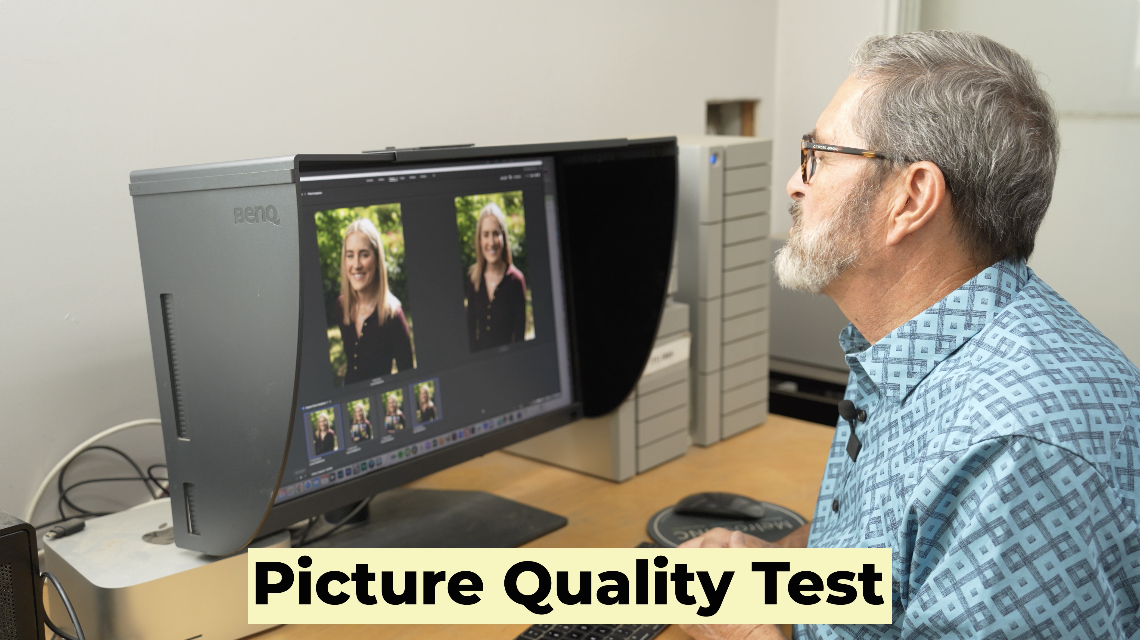 So let’s take a look at the picture quality between these two cameras. You know, Panasonic, I’ve always loved the picture on Panasonic and the Sony has always struggled a little bit to catch up. But when I look at it these days it is very, very similar.
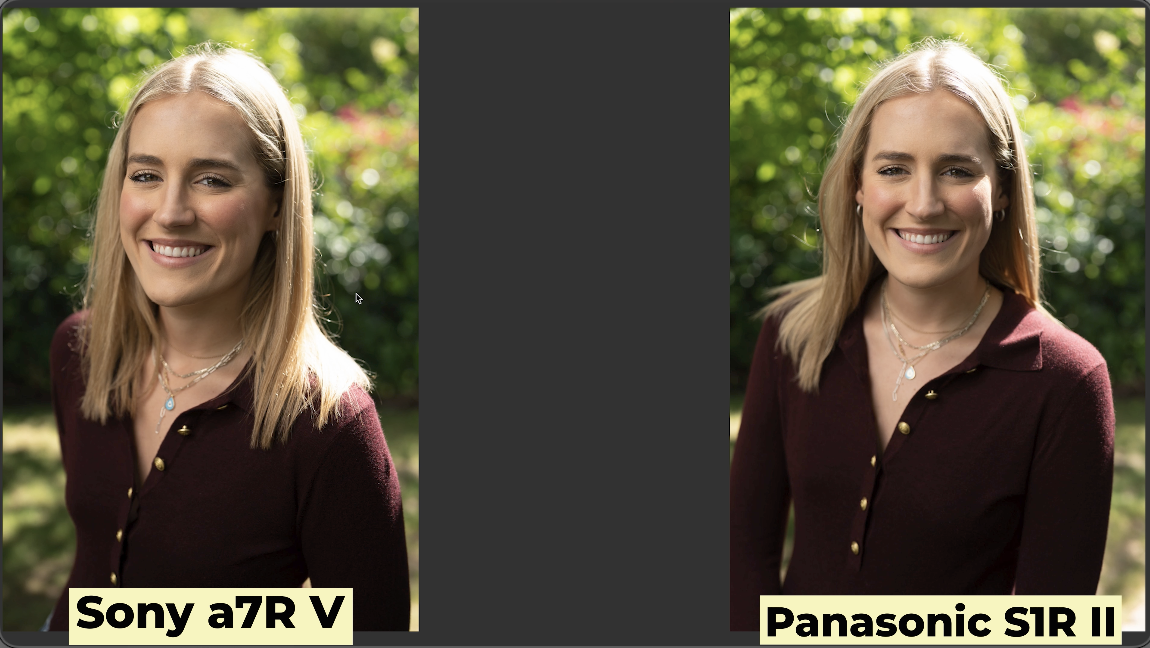 There is just a little bit of yellowish, a little bit of yellow in the background on the Sony. The Panasonic just gives us beautiful color, especially if we look at the color chart. The color just pops on the Panasonic.
  The Sony is good. It’s clean. It’s there, but the color just pops on the Panasonic. So I think when it comes to picture quality and color, I think the Sony falls a little behind. I think Panasonic is a little better. But in saying that, you certainly can correct the Sony to get it to where it looks just like the Panasonic. It’s not that hard to do. But the Panasonic, a little better picture quality.

All right, now let’s take a look at the ergonomics. Which one of these feels better? All right, let’s talk about the bodies of these two different cameras and just see exactly how they compare. 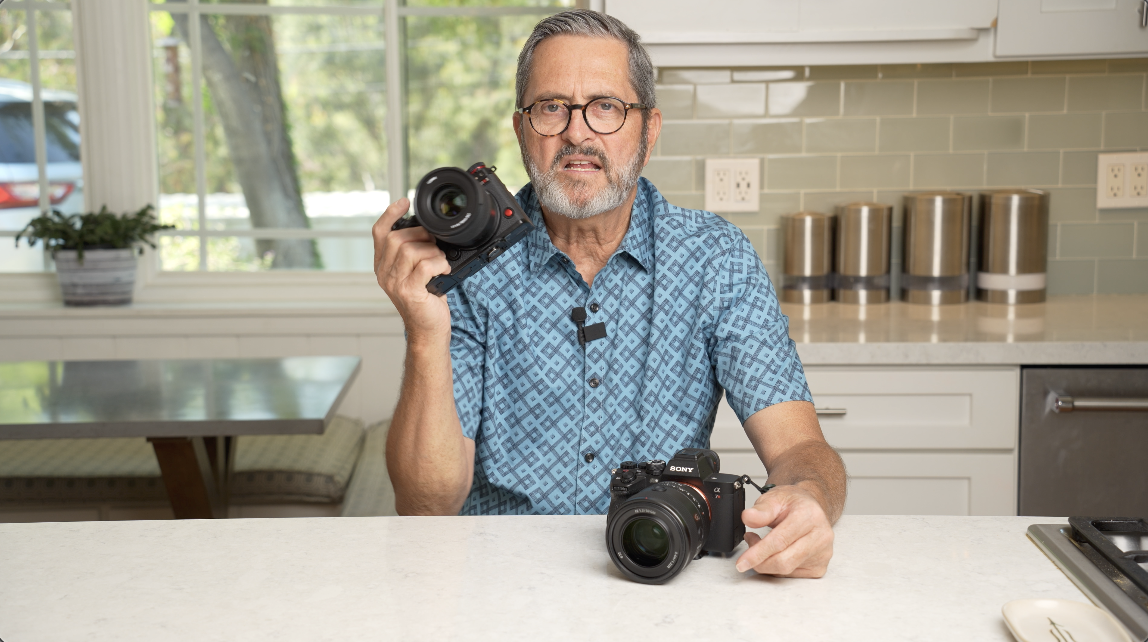 So, the Panasonic, I’ve always loved the grip on the Panasonic. It is a nice size for my hand. Whereas the Sony a7R V, it’s good, it’s just a tiny bit small for me.
 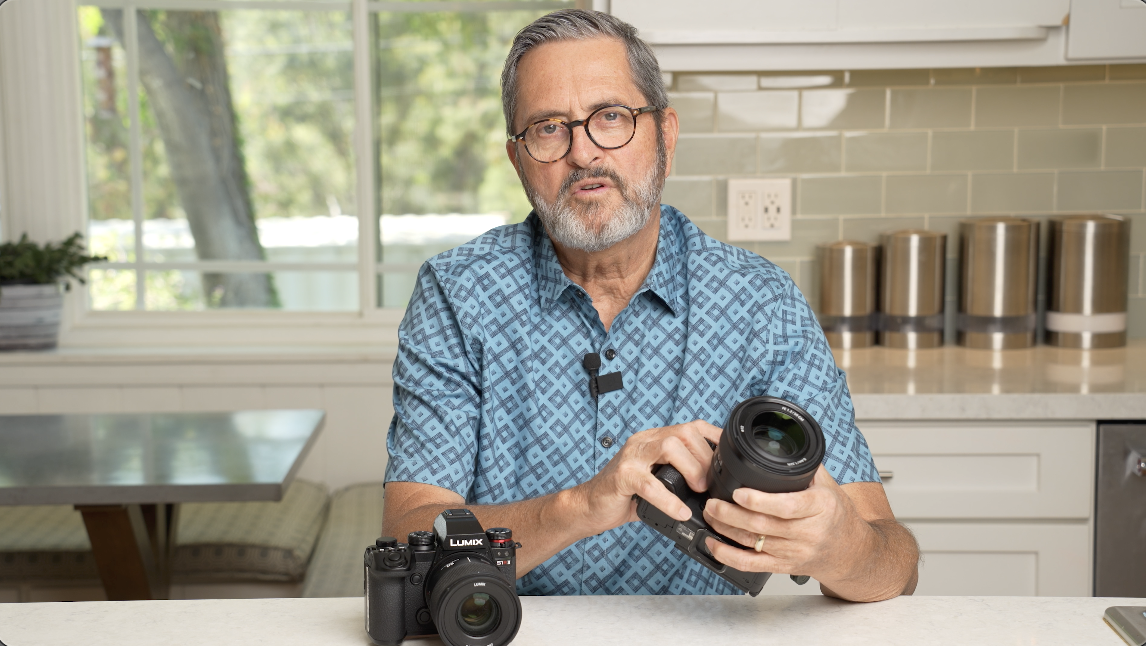 I feel like my little finger gets lost down here on the Sony. Whereas I think I feel like it’s just deep enough on that Panasonic that all my fingers fit right on there. It’s a little deeper grip and just a little more comfortable for me to hold. They’re almost the same weight. They are very, very similar in weight. But they’re just between that groove and the bottom of the body, they’re just not quite enough room for my little finger in there.

I do love on the Sony, the fact that I have access, that front wheel is easy for me to get a hold of. The back wheel is right where my thumb wants to be. So I’m holding it. It’s easy to move that. I do have the exposure compensation wheel there that locks as well on the front, but we have no secondary dial over here. 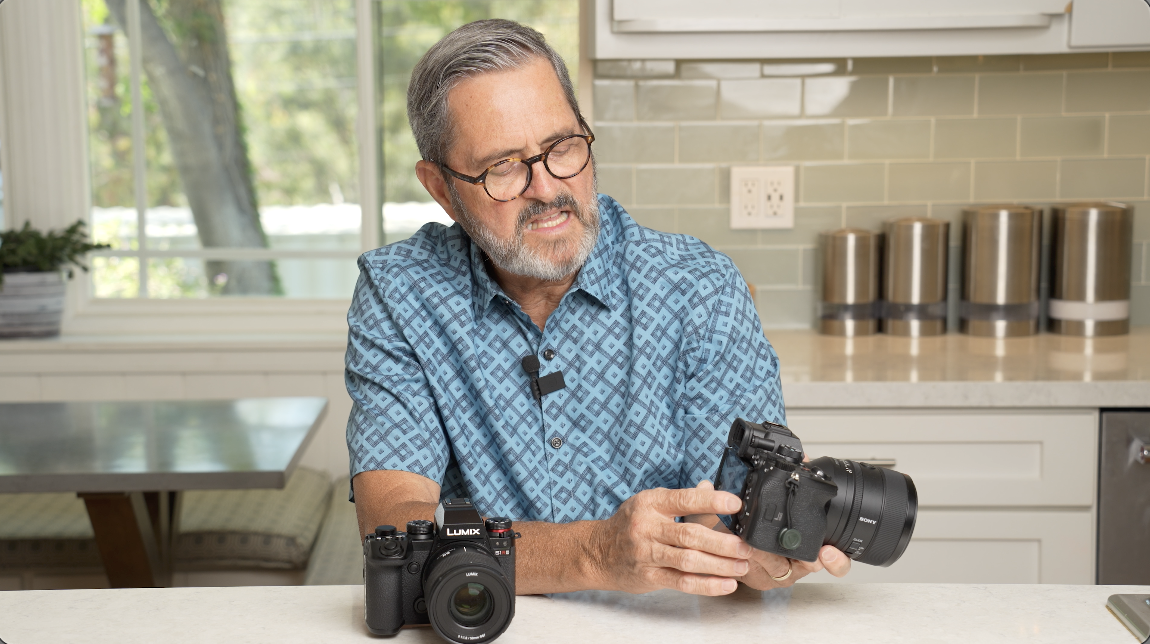 We see that on the Panasonic. The secondary dial basically is going to run all of our different frame rates. Whereas on the Sony, you get to that access by clicking on here and you have all your frame rates set up in the back. So that’s just a matter of how easy that is to access. I’m so used to doing it on the Sony that it’s kind of second nature. But I love the dial because I can see exactly how many frames and where that’s at. And that’s a nice feature.
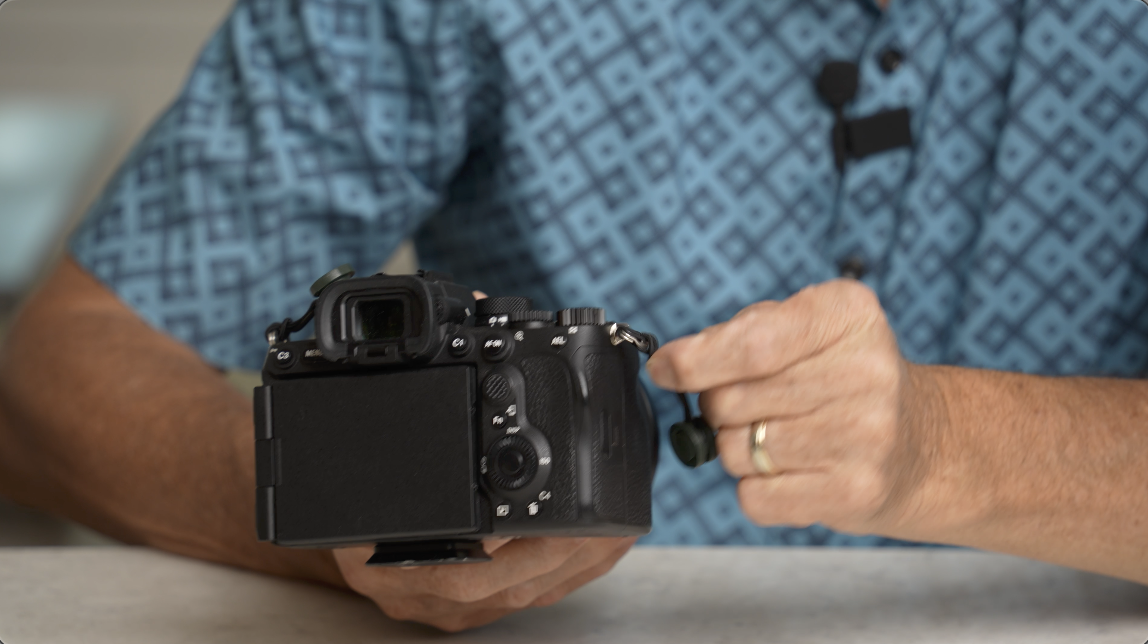
I don’t love these rings on the Sony. Never have. This kind of a ring just gets in the way. Whereas I like the metal attachment for your camera strap. I like that much better. 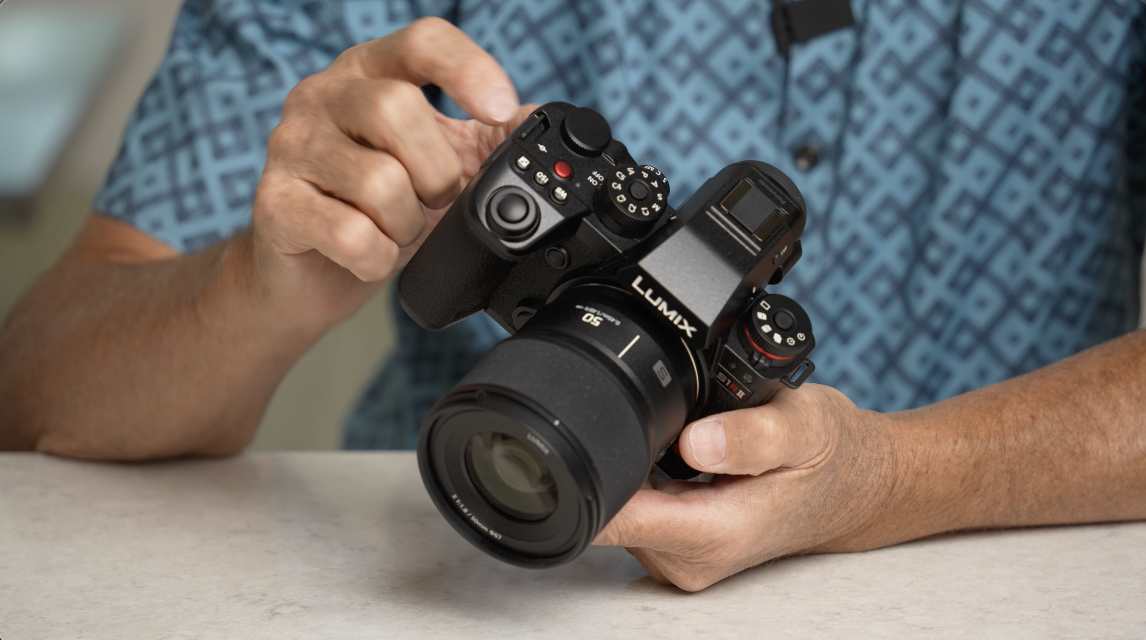 It’s a fixed position. Easy to put into cages, easy to attach to. So the Panasonic, I think, has an advantage on that versus these rings you see on the Sony.
  I do like the Sony’s doors. I think it’s probably the best of the cameras I’ve been looking at recently. They are nice and weather sealed. They are easy to open and close. It doesn’t feel like there’s any play in them.
 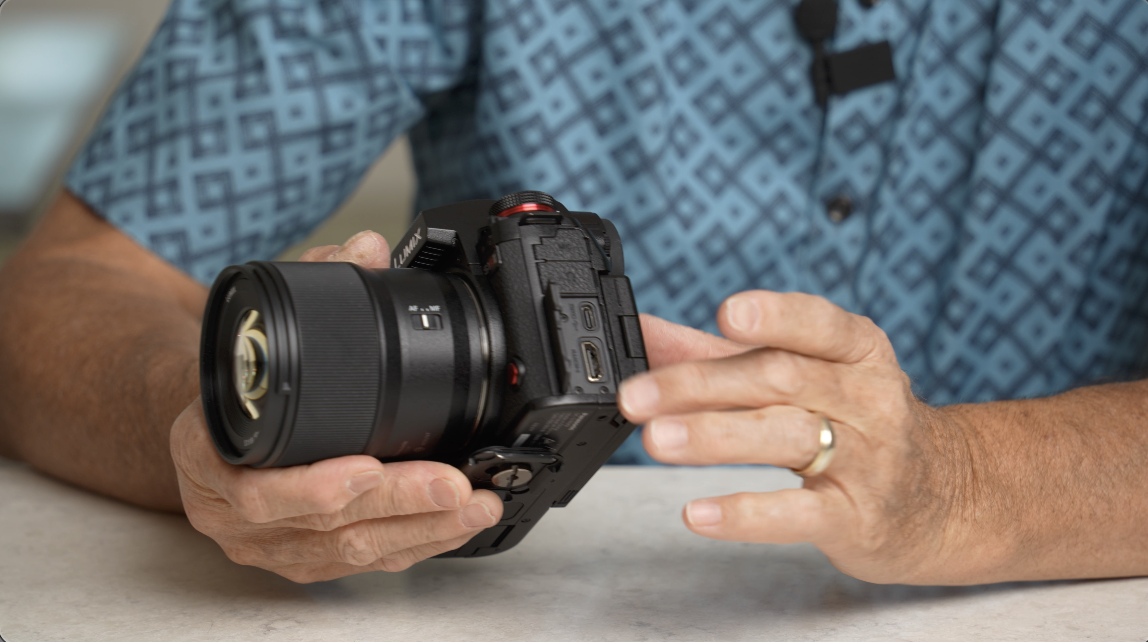 The Panasonic has a very nice, their doors are nice as well, but they’re just a little more flimsy. They feel like they’re going to break off. I feel like this is just a little more a little beefier, a little nicer on the Sony.
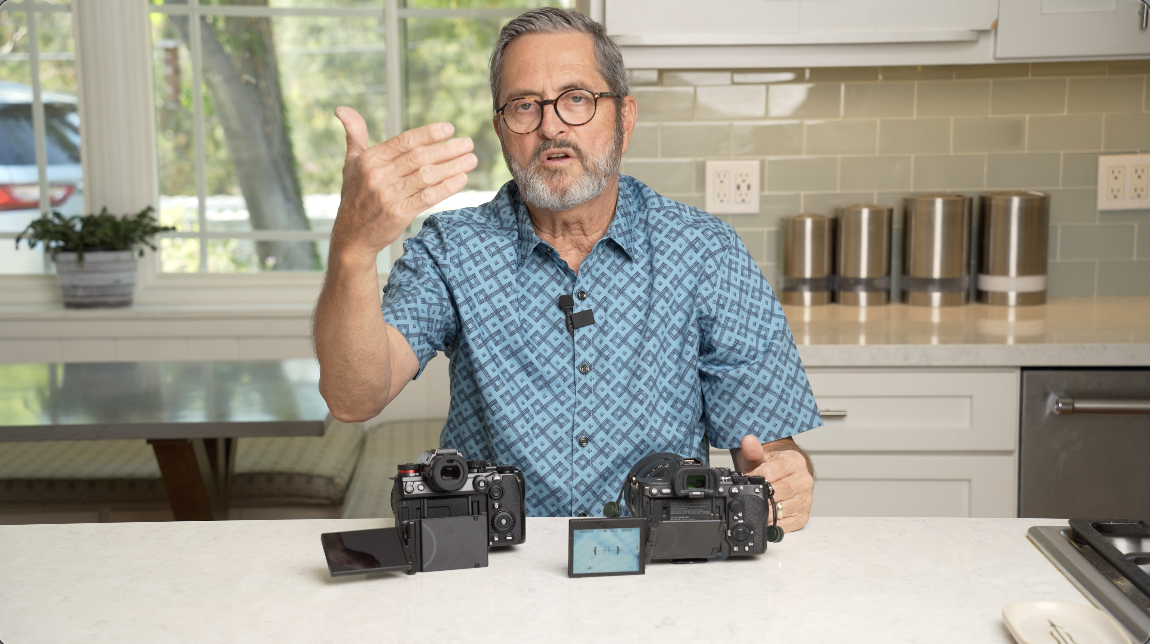
The back screen on these two cameras is almost identical. It pops out all the way out and around. In fact, it looks like the same screen if you look at it. Even has that same circular pattern on the back. It is exactly, almost exactly the same screen as far as what it does. So, both of these cameras are perfect for that. If you want to vlog with them, flip it around and look, or if you want to put it into someplace tight, you can flip that screen back towards you. So, both these have a really nice pop out screen that’s perfect for different applications.
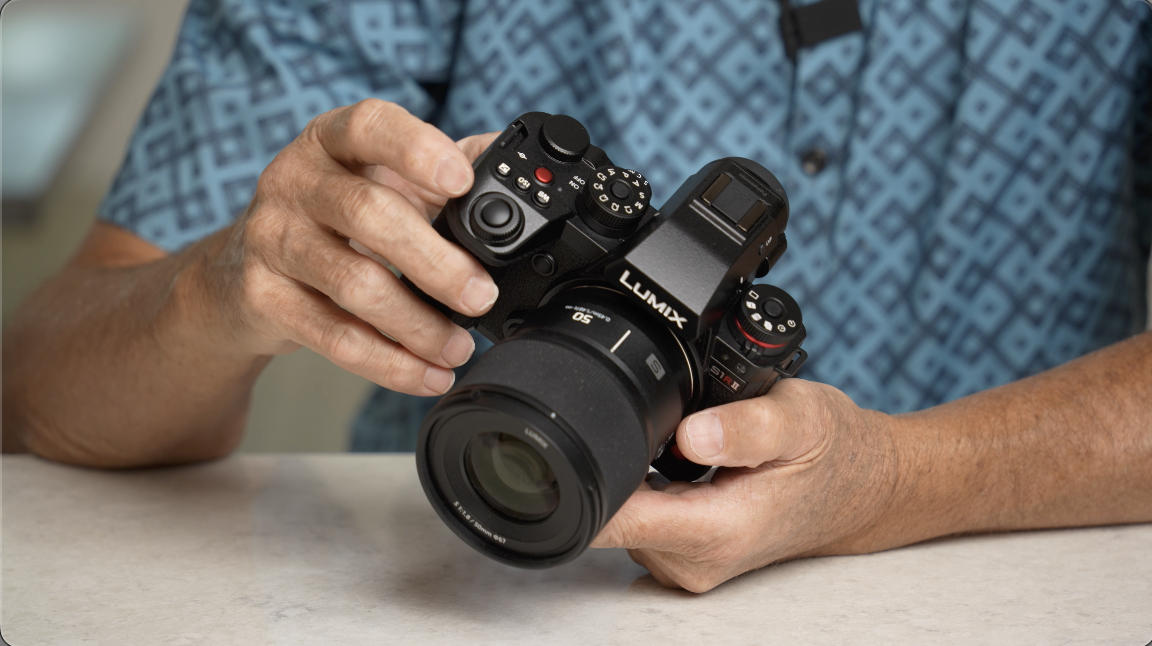
The record button on the Panasonic is a little hard for me to get my finger to. And on the Sony it’s about the same. It’s just hard for me to get to. It’s, I’ve got to bend my finger back to get that. The Panasonic, you can change this to be able to use and to start the recording with just the regular trigger button if you want. That’s an option you can put in the menu. So, you can use that. Whereas with the Sony, you’ve got to use that record button. It’s a little hard to get my finger back to.
 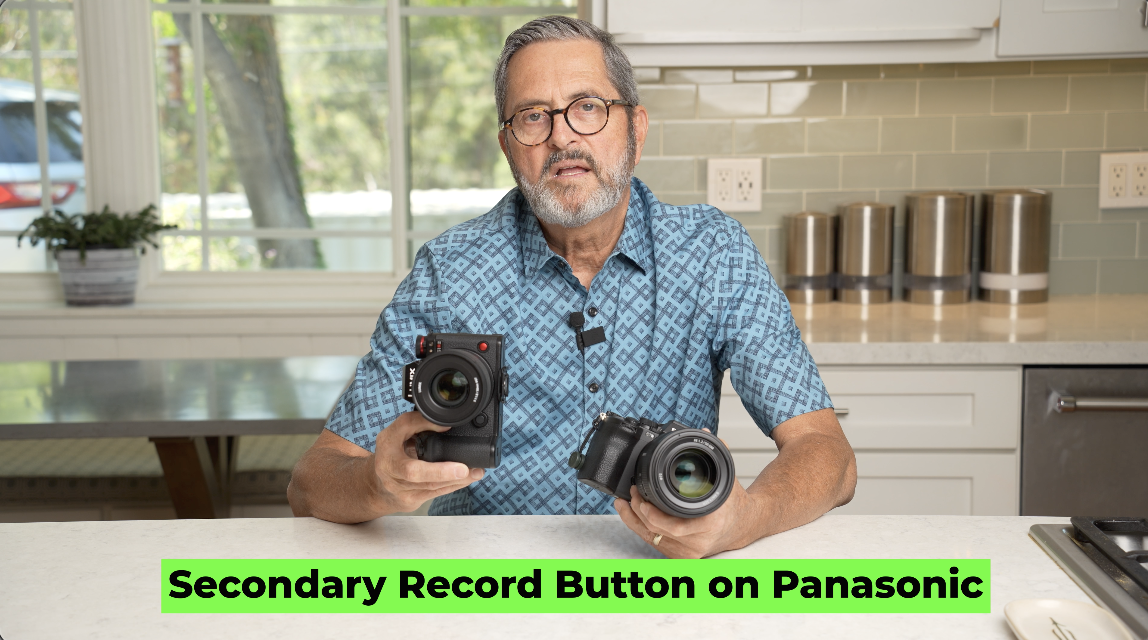 The Panasonic also has a secondary record button on the top on the front which allows you to hit record from the front. You don’t have that on the Sony. The Sony does have more buttons to program.
 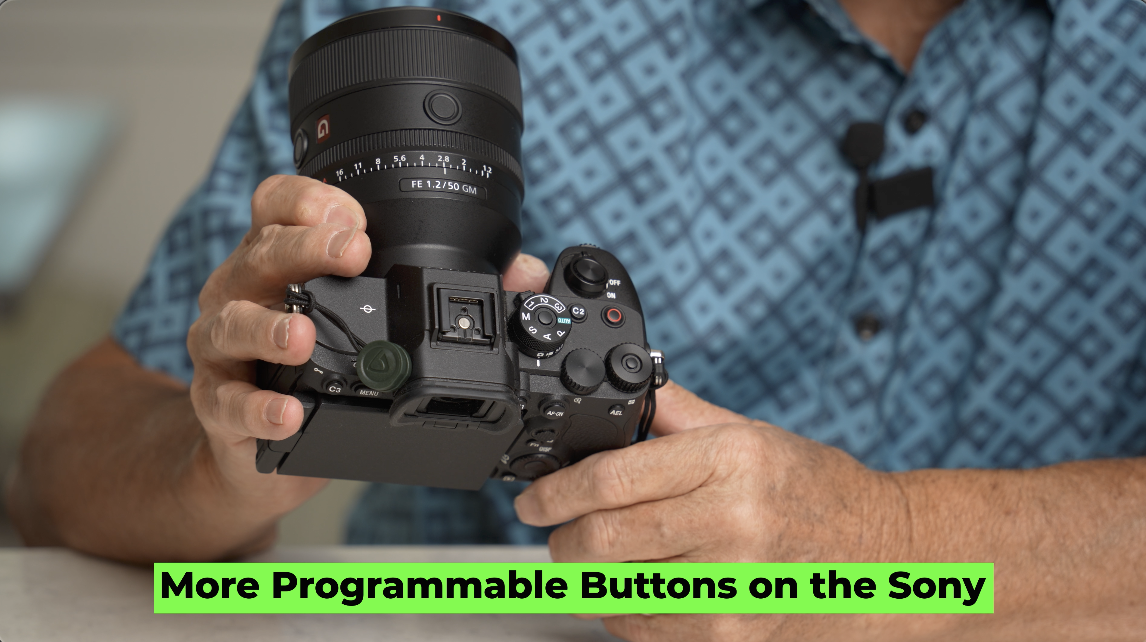 We’ve got C1, 2, and 3, which allow you to have three different options to be able to program to. I think the Panasonic has one. Yeah, just does not have as many buttons that you can program to be able to change and to set the things you would like to access with the buttons on the camera.
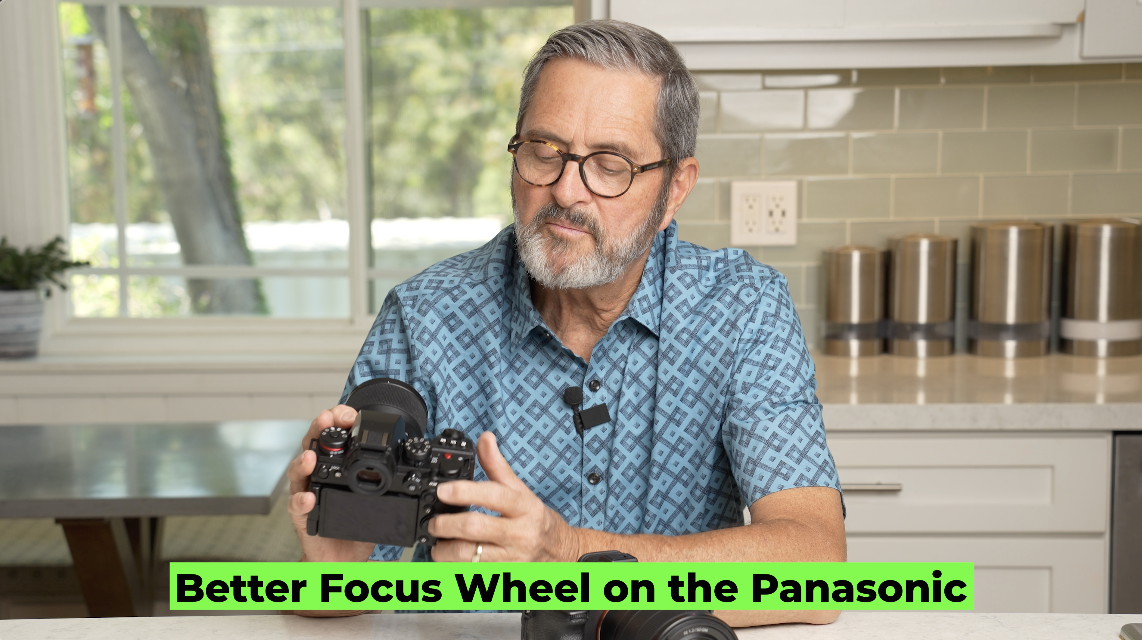
So, on the Panasonic, I love the white balance, ISO, and your exposure composition. Just buttons on the front, easy to get to. Whereas on the Sony I just have programmed, I know that the 2 is changing my focus area. I know that the 1 is going to change my white balance and that the 3 over here is going to change my regular continuous or single frame focus or manual focus. 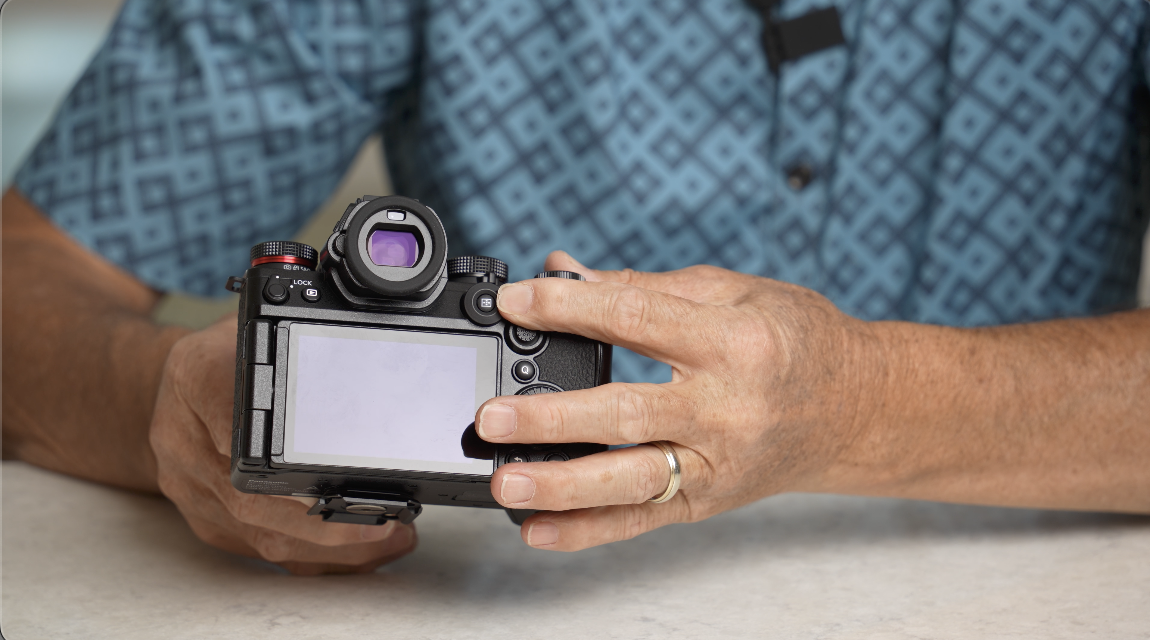 I think the way Panasonic has set up the focus here, access to focus on this little wheel is really nice. You can go from manual to single to continuous. You can push the button on the back which allows you to change your different focusing, different focus patterns. All that’s really concentrated in this one spot. Whereas on the Sony, I’ve got it in two different places I have to go to, to be able to make those changes. I don’t change, I shoot on continuous focus almost all the time. I don’t change it to single very often. But sometimes there’s applications where you do want to do that. So there you go. The ergonomics.

Weight wise, these cameras are about the same. They’re very small, very, very similar in size and weight, which makes them just very competitive with one another with regards to the ergonomics.
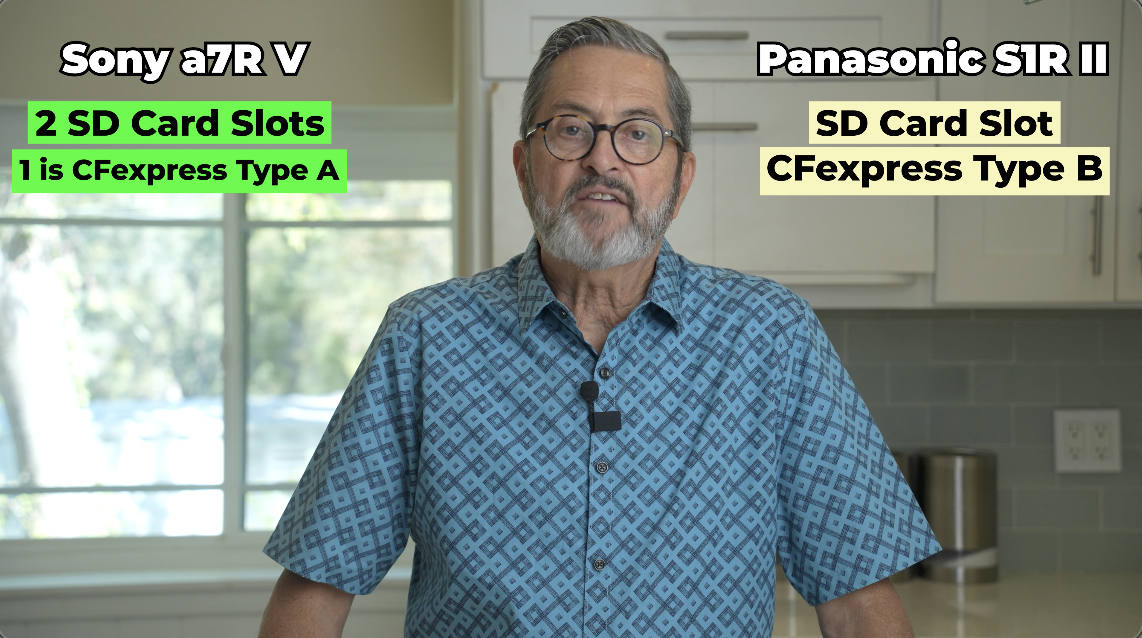
I think card slots on these cameras are different and interesting because on the Panasonic, you’ve got an SD card slot and you’ve got a CF Express Type B slot. So you can use one of each of those. The Sony has a really interesting interface that I like very much. And that is that they have two SD card slots, but one of them is a CF Express Type A slot. So, you can use either an SD card or a CF Express Type A card in that slot. Panasonic or Sony just came out with some newer, larger, faster CF Express Type A cards as fast as 900 megabytes. So there’s a lot of support for that CF Express type A. It’s interesting because most other cameras are using type B cards whereas Sony has stuck with that type A card mostly because you get the dual use of that slot, an SD slot that’ll also work as a CF express type A slot. So I think there’s a bit of an advantage there. You can run two SD cards or you can run a faster card for doing video.
When it comes to the monitor on the back of these two cameras, the Sony has a 3.2-in just slightly larger than the Panasonic which has a 3-in monitor. The Sony has a 2,095,104 dot resolution whereas the Sony or the Panasonic has a 1,840,000 dot resolution. So, the monitor is slightly larger, has a little more resolution, but they’re very similar. You can, you really have to pay attention to see the difference in those two if you compare them when you’re shooting something.As far as the angle and swing and everything on the two back screens, we talked about that in the ergonomics. They really are very similar. They have a very similar kind of interface, it is, I think perfect. I think it’s the perfect setup. You can pop it straight up to look down. Pop it to the side if you want to vlog with it. You can put pop it to the side and turn it around if you want to stick it into a tight corner or something. There’s just a lot of capabilities with that screen which I really like that touchscreen, that touchscreen interface.
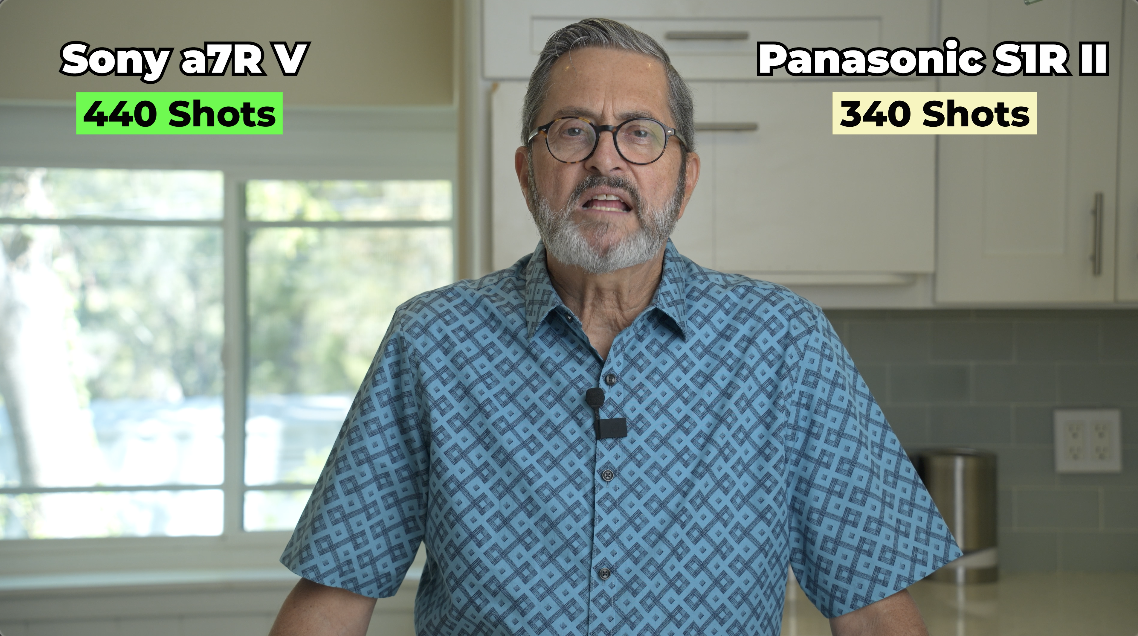
So the battery life on the Sony gives you about 440 shots whereas the battery life on the Panasonic is about 340. So the battery is a little more robust in that Sony and gives you a little more, gives you more shots on the one battery.
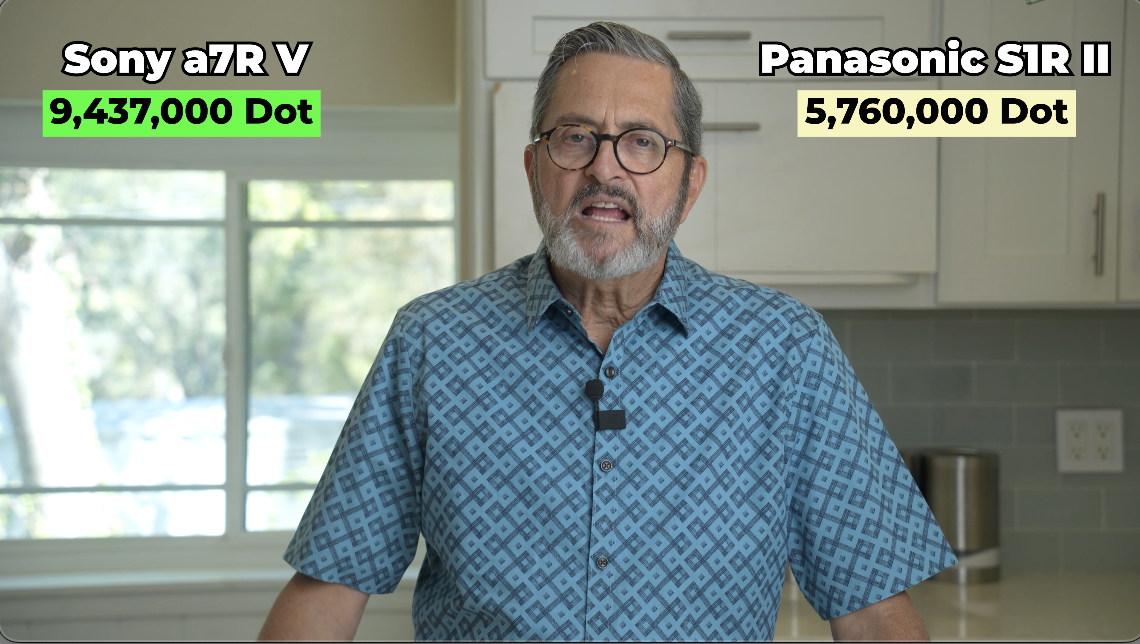
Viewfinder resolution though is really interesting because on the Sony you’ve got a 9,437,000 dot plus some viewfinder whereas with the Panasonic you’ve got a 5,760,000. You see the difference in that when I look through the Sony I can really look and see. I review images through that viewfinder. I love using the viewfinder, especially when it’s, you know, bright outside, the sun’s shining. But I use the viewfinder all the time. I’m looking in there. It doesn’t matter whether I’m inside or outside. I just feel like I can see better and it gives me a better idea of what it is I’m shooting. I love the viewfinder on the Sony. It really gives you a great view of your images. And I think that’s a superior item on the Sony.
Autofocus points are really interesting. The autofocus on the Sony gives you 693 phase detect whereas with the Panasonic you have 779 phase detect and AI tracking autofocus. So let’s take a look at our autofocus stills test now and just see exactly how these two compare with each other.
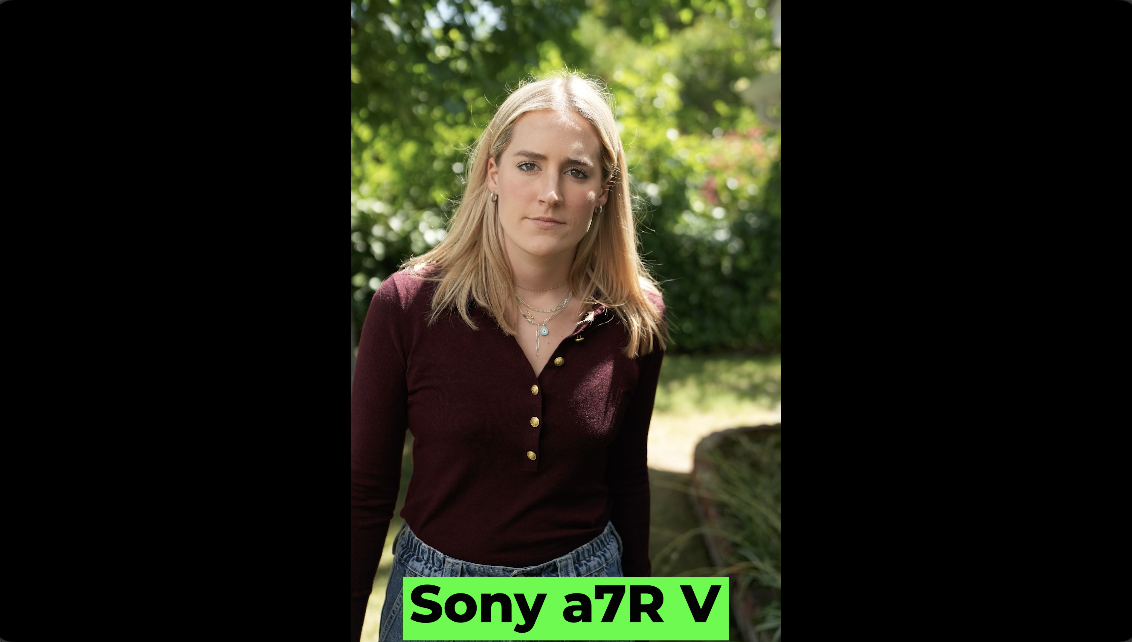
So when it comes to autofocus in still mode Sony is very difficult to beat. I ran the test twice.
Well, I ran it several times, but I would get, I got every frame most of the time on Sony. One time I lost a frame slightly. But it was still pretty close. It wasn’t like way out. So the Sony is really, it’s spot-on when it comes to autofocus. It does an excellent job. 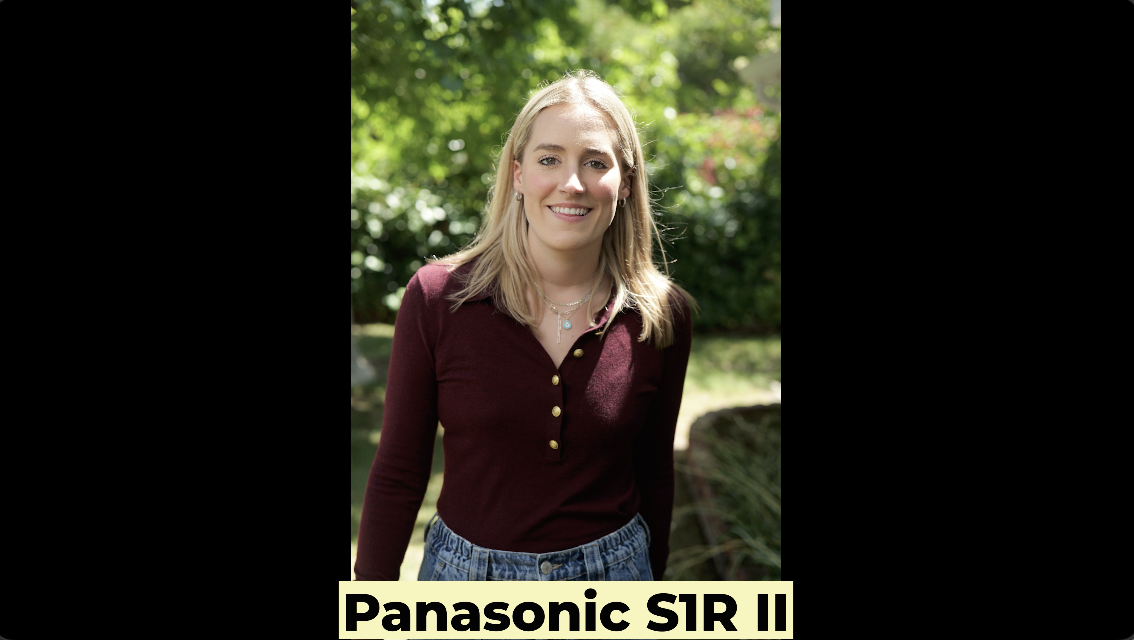 The Panasonic, I lose about 10%. So if you’re doing 40 images, you’re going to lose about four. It’s just, it’s been pretty consistently that every time I’ve run this test. And you can just see that in as you test it, you know, I’m losing four or five out of 45. And so it’s just consistently about 10%. So Panasonic just is not quite keeping up when it comes to still mode autofocus. It’s not quite there. Very, very, very close. I mean, it’s really head-to-head, but the Sony edges it out.
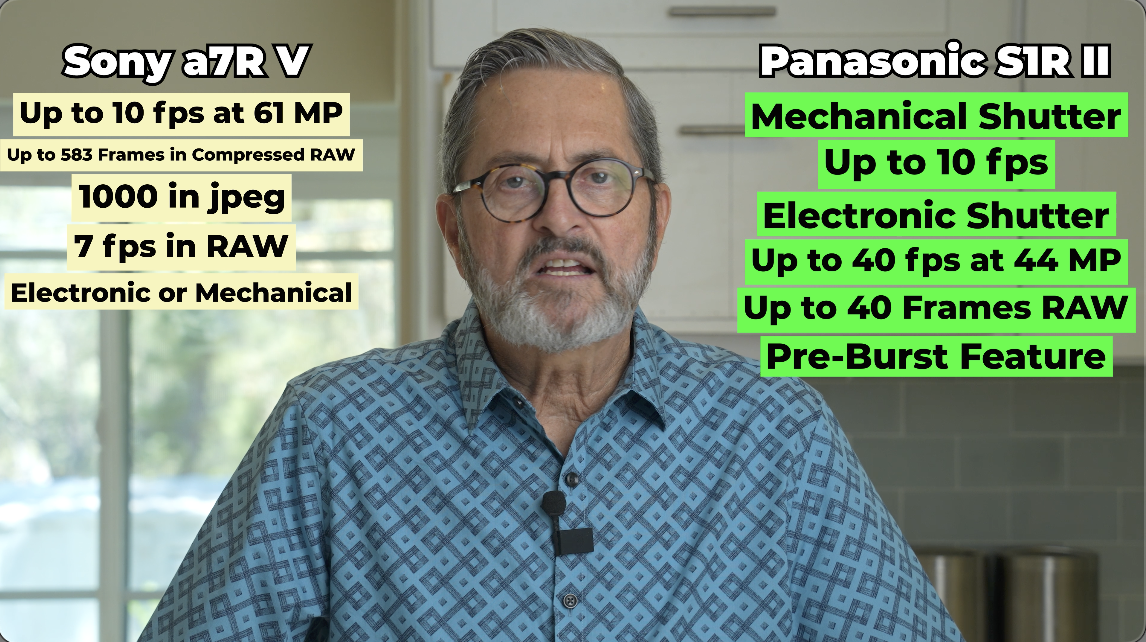
So, let’s talk about the continuous shooting rates on these two cameras. The Sony will give you up to 10 frames per second at 61 megapixel images up to 583 frames in compressed raw or 1,000 in JPEG. If you go to a full raw image on the Sony, you’re going to drop down to seven frames per second. Now, that’s both in the electronic or the mechanical. So, I shoot mostly mechanical shutter on the Sony because I don’t want to deal with the banding you get sometimes with the electronic shutter. And it just, it gives you a great output. If I am shooting RAW, it’s going to give me seven frames, and I feel like that’s really adequate for most of the things I’m doing. So, on the Panasonic, you get 10 frames per second in mechanical shutter. But in electronic shutter, you’re going to get 40 frames per second. So, you’re getting 44 megapixels at 40 frames a second. You can get 40 raw, full raw out of that. But the really interesting thing about the Panasonic, the thing that I love the most, and I have used this feature, is the pre-burst. Basically, when you wake the camera up and you’re looking at an image and the bird flies, when you hit the button to start recording, you can have set your camera to have pre-recorded a half a second, you know, 3/4 of a second. It can give you all the images before the bird took off. That’s a feature that is really super helpful, super useful, and works really well. I’ve used it several times. I like that feature a lot. So that electronic shutter really is when you say 40 frames per second, that’s a serious frames per second for sports, for birds. I mean, that really is in a great category uh on its own there. So an electronic shutter, I think, is definitely superior in the Panasonic.
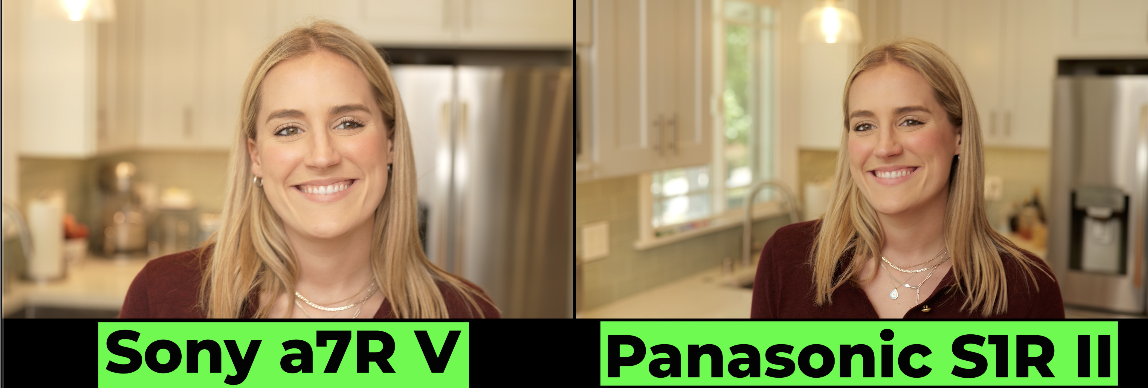
So now let’s take a look at some of the video aspects of these two cameras. Let’s start with an autofocus video test. Let’s take a look at that. When it comes to autofocus in video mode, the clips that I shot, both of these cameras were pretty much right with her. She would turn around, she would turn back, they stay right with her. Sony had a spot in one little place where it kind of maybe lost it for just a millisecond, but not really, not enough to make it where you would notice it or cause a problem unless you’re really focused on it. So, I think that both these cameras did really well with autofocus in video mode. I think they’re really head-to-head. You tell me what you think looking at those clips.
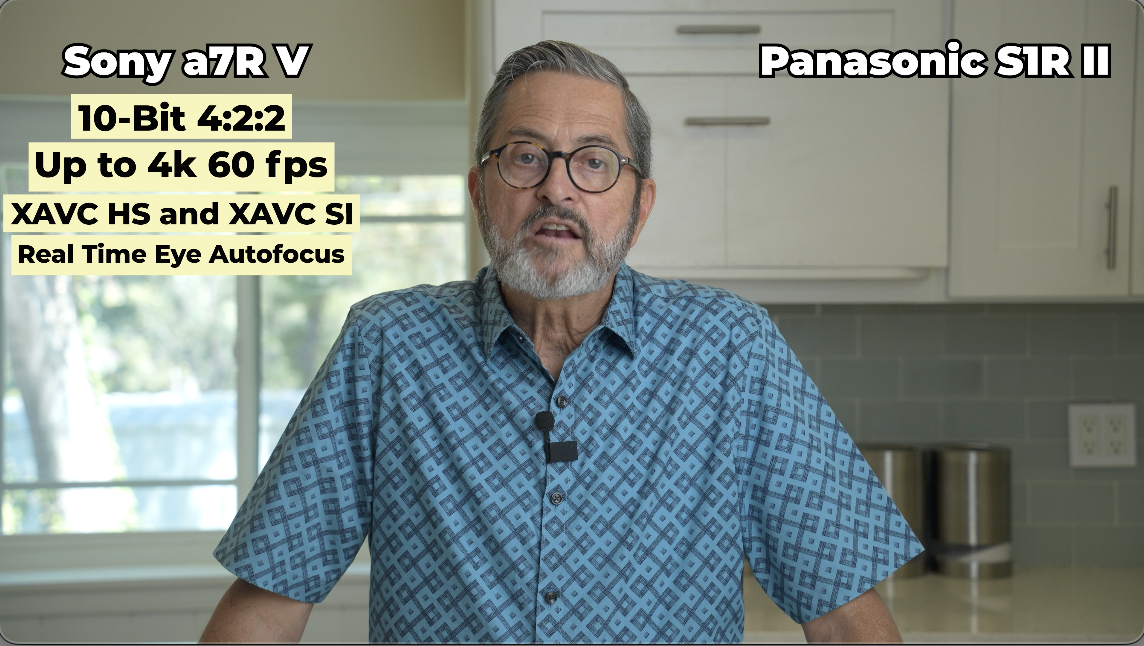
Let’s look at the video capabilities of these two cameras. First off, the Sony shoots an 8K video. It records in 24 frames a second and 4K at 60 frames per second. It’s got a high resolution sensor, fast processing capabilities, really gives you a beautiful image. You can also shoot an XAVC HS10 bit video using the full width of the sensor. 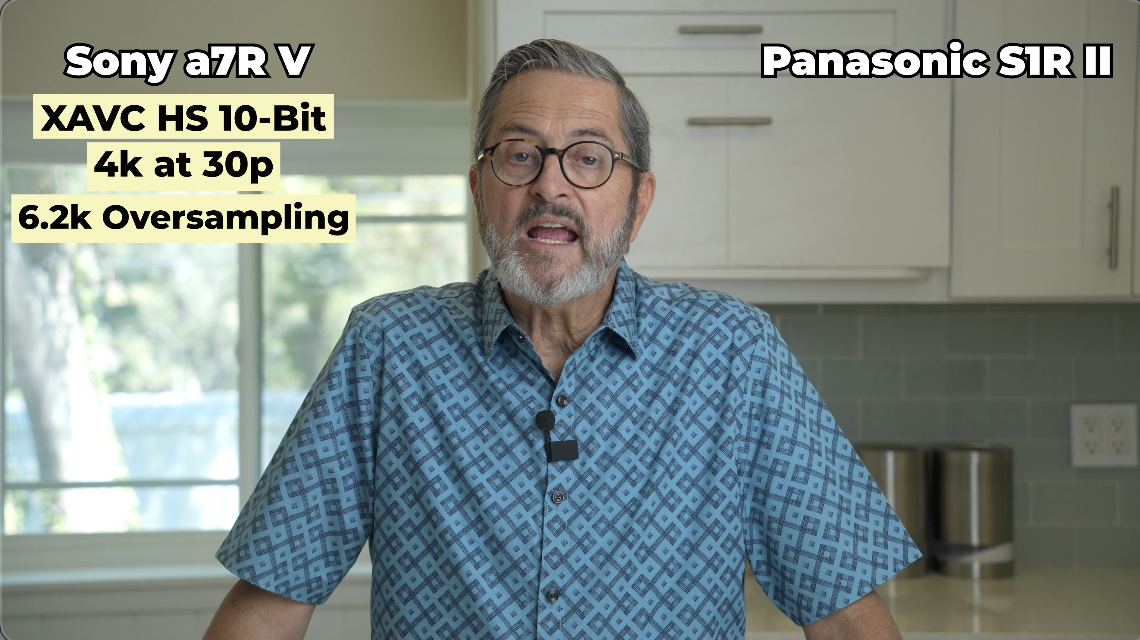 If you go to super 35 crop, you get up to a 4K at 30p or 6.2K over sampling. So, it gives you a beautiful oversampled image. Internally, you get 10 bit 4:2:2 up to 4K 60 frames a second and an XAVC HS and XAVC SI and real-time eye autofocus is fully supported during video recording for the subject detection and tracking of humans, animals, birds, whatever you photographing. So, there’s really great robust video capabilities with the Sony.
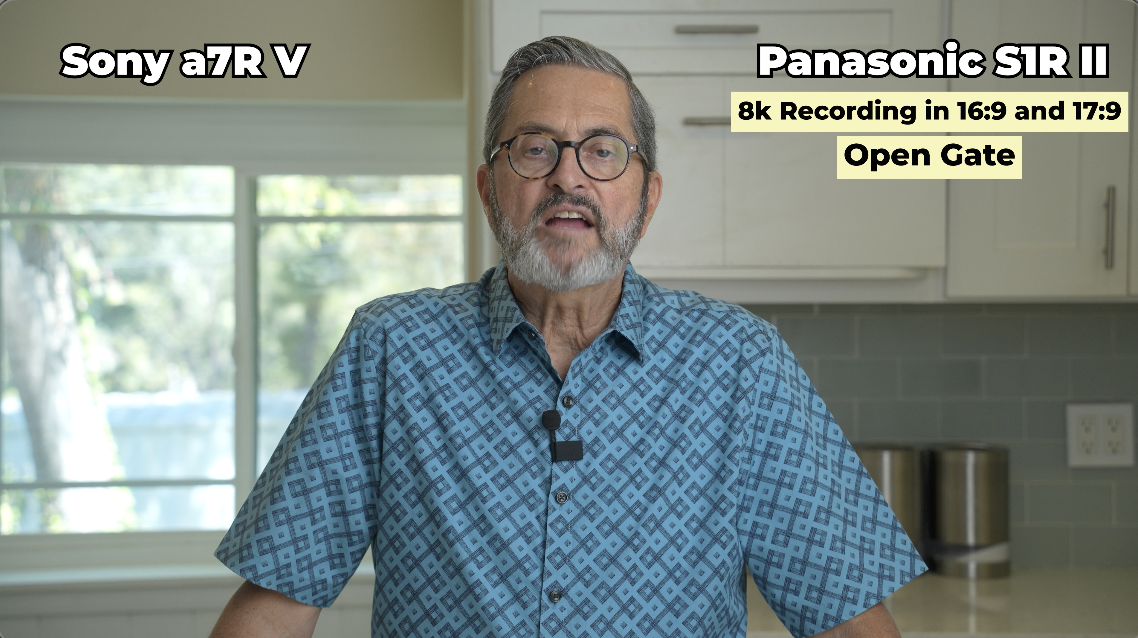
Let’s take a look at the Panasonic here. The Panasonic shoots 8K in 16:9 and 17:9. It’s 8K open gate. So that really gives you an open gate format to be able to shoot and to crop. Whether you’re doing social media, whether you’re doing combination of social media, YouTube, doesn’t matter what you’re doing. It gives you that full frame to be able to reposition. I think open gate really is a very positive way to shoot. 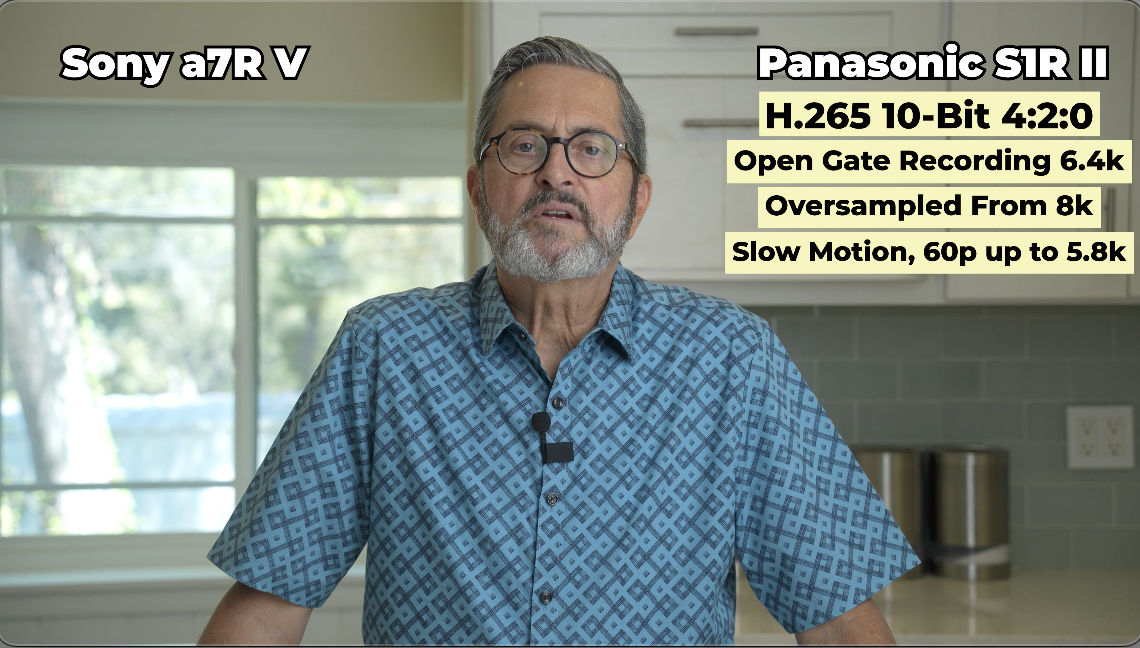 I wish all cameras would do it. I think eventually they will. But in that open gate mode, it’s an H.265 10 bit 4:2:0. So there’s not as much information as the 4:2:2 modes. Open gate is recording 6.4K. It’s recording full width. It’s oversampling from that full 8K. So it gives you a beautiful image. It’ll do slow motion up to 60 frames a second at 5.8K with just a small 1.1 crop which is pretty common.
  You can do 4K at 120 mode on the full sensor width but it’s subsampled making it softer and not quite as clean an image that subsampled but it does give you 120 frames a second which is pretty unique in this category of camera price-wise. You do have rolling shutter with this camera just as well as you do the Sony. I mean it’s just very typical because it’s a single sensor. It’s not a stacked sensor. So you’re dealing with rolling shutter. So, let’s take a look at a couple of samples of the video from these two cameras side by side.
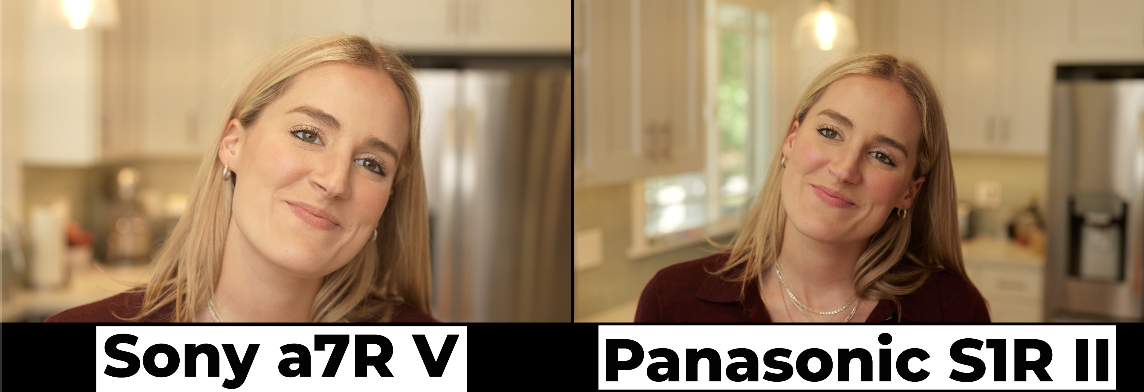
So, there’s a look at the video between these two cameras. Really the Panasonic gives you a very beautiful image. It gives you a lot of recording options. I absolutely love the support that they lean into at Panasonic and the S1RII certainly does this, that they allow you to shoot anamorphic lenses that they have.They can show you the de-squeeze in the viewfinder. It allows you to see that. I think it’s really important. I love shooting on anamorphics. I wish that other cameras would kind of go that direction. I wish Sony would go that direction. The a7R V does not do that. There’s no recording limits on these two cameras. The Sony’s going to shoot S-log 2 and S-log 3, and the Panasonic is going to shoot V-log.
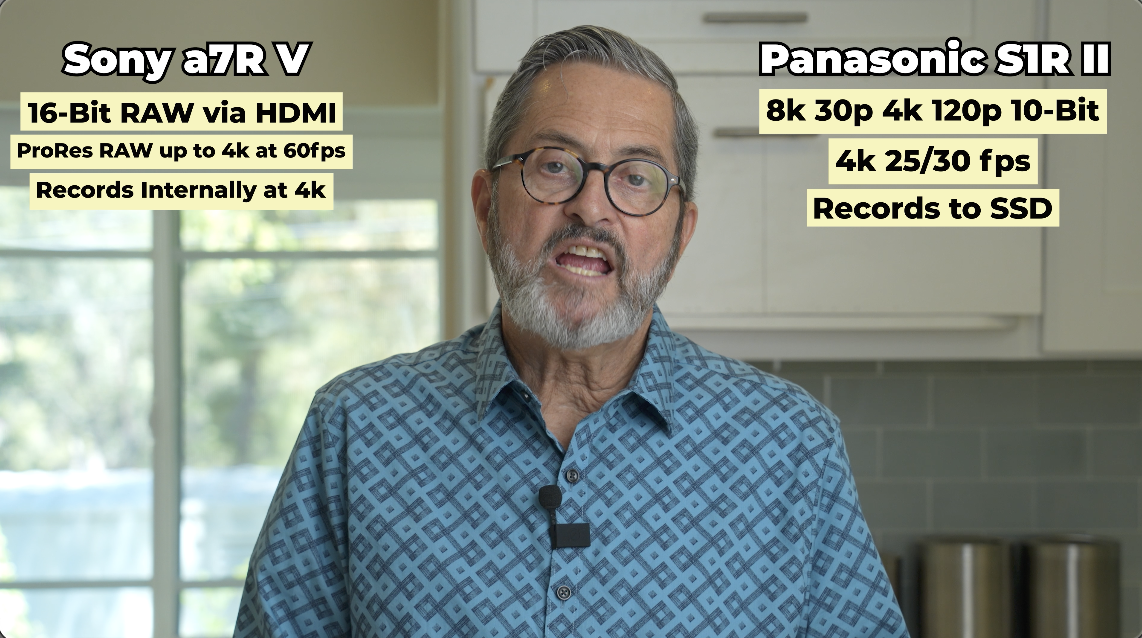
When it comes to external recording between these two cameras, the Sony does a 16-bit RAW via the HDMI, full HDMI port. It has ProRes RAW. That raw output goes up to 4K at 60 frames a second, and it’ll simultaneously record internally 4K at the same time. The Panasonic S1RII, it has an external recording of 8K at 30, 40 and 4K at 120. It’s 10 bit 4K, 25, and 30 frames a second. Both cameras have that same full size HDMI video port. The nice thing about the Panasonic is they also have a USB-C port that allows you to hook to an SSD. And this gives you the ability to use an SSD drive. You can hook on the side of a cage. It gives you much longer recording times, fast recording if you’re doing that high-res video, and makes it just really useful. I think that’s an advantage the Panasonic has. It really makes the video capabilities of that camera more on a professional level. Ready to move into the market and be able to use in so many different situations. So, there’s a look at the video capabilities of these two cameras. Sony is really a very good video camera. Really robust, gives you great codecs. It’s an excellent platform, but it does not compete with the Panasonic, I don’t think. Panasonic is far superior in so many different ways. The types of capabilities it has, the options that you have to use it really make it into a professional application camera.

Both cameras have five axis image stabilization. So, it makes it so you can handhold these at much lower shutter speeds. The IBIS on these two cameras are very different. So, let’s take a look at the IBIS, the test that I did with the IBIS using the Sony and the Panasonic together. 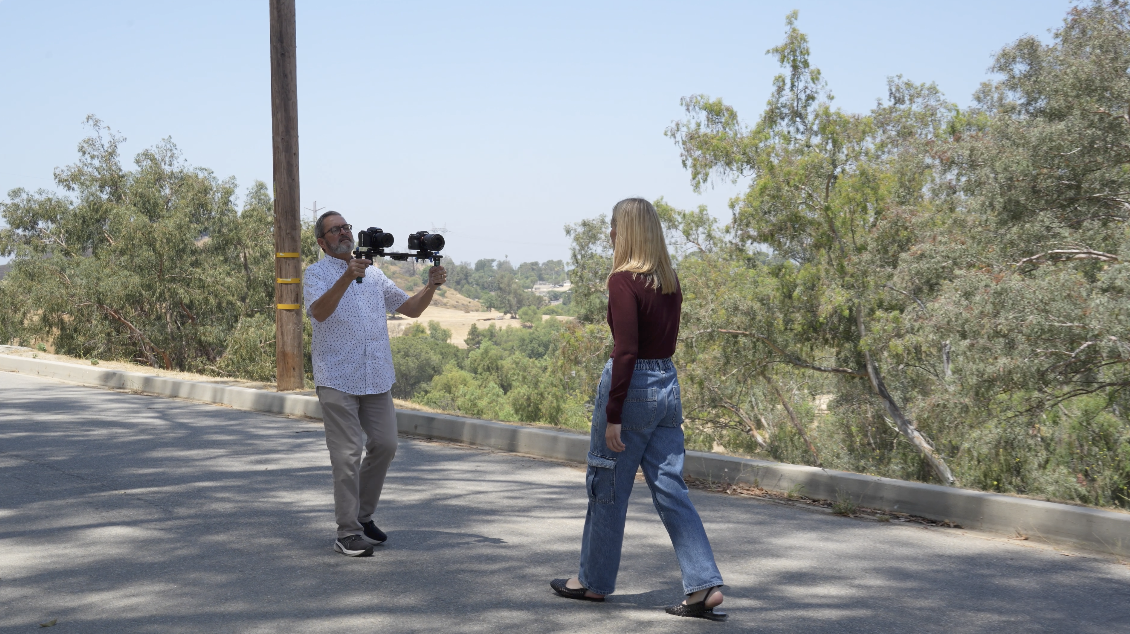 So, when I look at the video stabilization between these two cameras, I’ve got it on a rig. Both these cameras are sitting on the same rig. They’re getting the same bounce. And Panasonic is just very smooth. I mean, every time I look at the Panasonic, when it comes to stabilization and video mode, Panasonic is beautiful.
  The Sony’s very bouncy. It’s not near as pretty. You would have to enhance this. The enhancement is not turned on either of these. That would help the enhancement. You probably have to do some warp stabilization in Premiere as well. So, pretty obvious to me that when you look at stabilization in video mode that the Panasonic is definitely winning out.
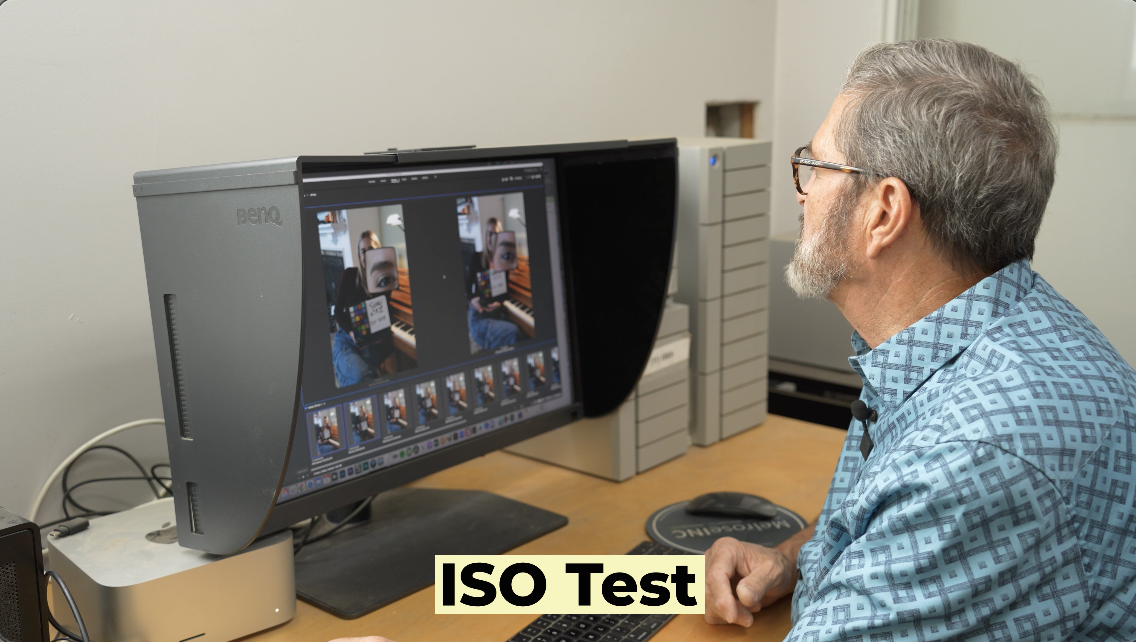
So, now let’s take a look at the ISO test. All right, let’s take a look at the ISO test between the Sony a7R V and the Panasonic S1R II. I start at 400 ISO and both of these cameras are clean as could be at 400 ISO. 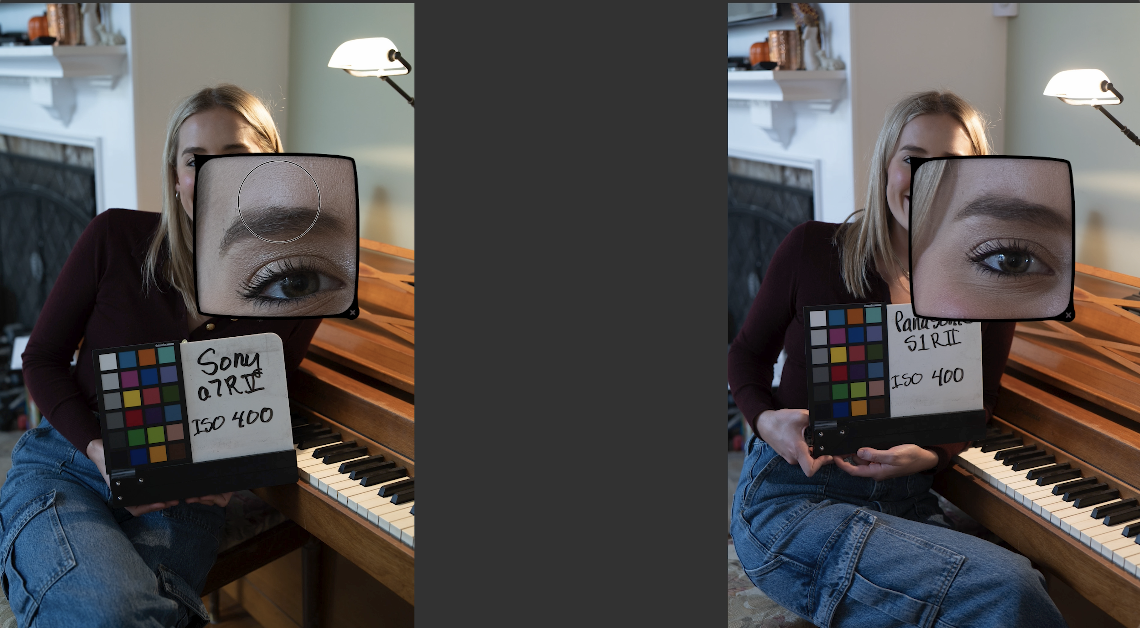 We jump up to 800 ISO. I look at her eye, it’s very clean. I look at the background, some of the area in the background, I start to see some a little bit of digital noise gathering. A little more on the Sony than the Panasonic.
  When I go up to 1600 ISO, look at her eye and it’s pretty clean. I look at the transition on the nose, bridge of the nose, there’s usually kind of a color that starts to build. Sony looks pretty good. Panasonic looks good. If I look in the background, I start to see the digital noise building back there. And it’s definitely pronounced. They look very similar to one another. Maybe the Panasonic is edging out the Sony.
 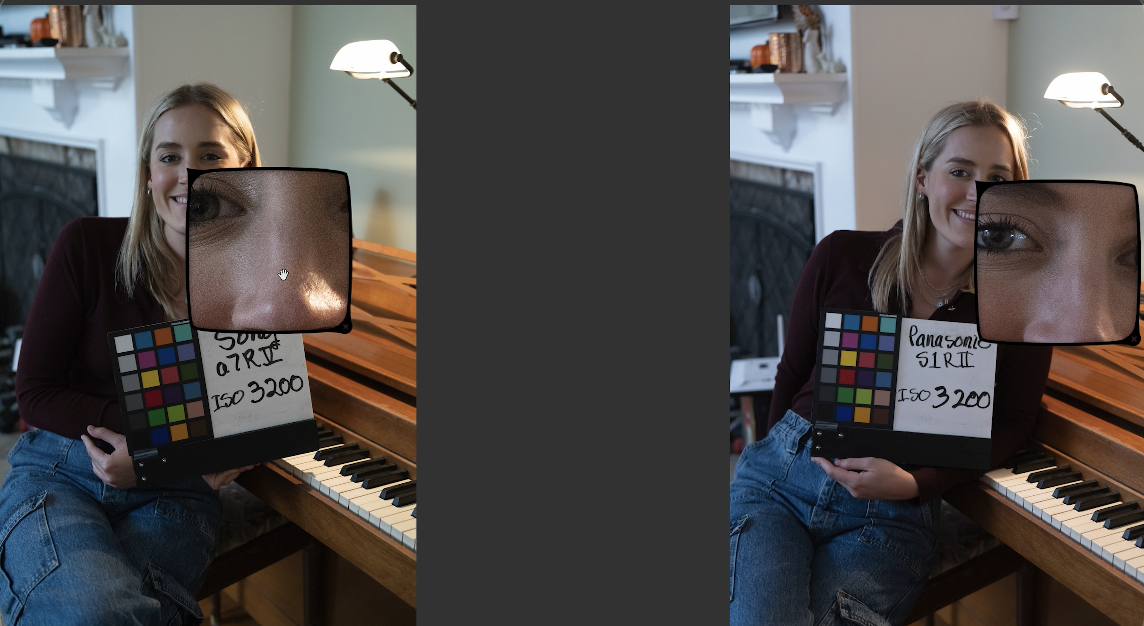 Let’s look at 3200 ISO. We go up and we take a look at her eye and the bridge of her nose. I’m starting to see that digital noise. You start to see it in the bridge of the nose. It just, the skin starts to feel like it no longer has the kind of rich kind of depth that you want it to have. It’s starting to just feel a little bit like it’s digitally falling apart. And if we look in the background, the Panasonic looks really good compared to the Sony at 3200 ISO.
 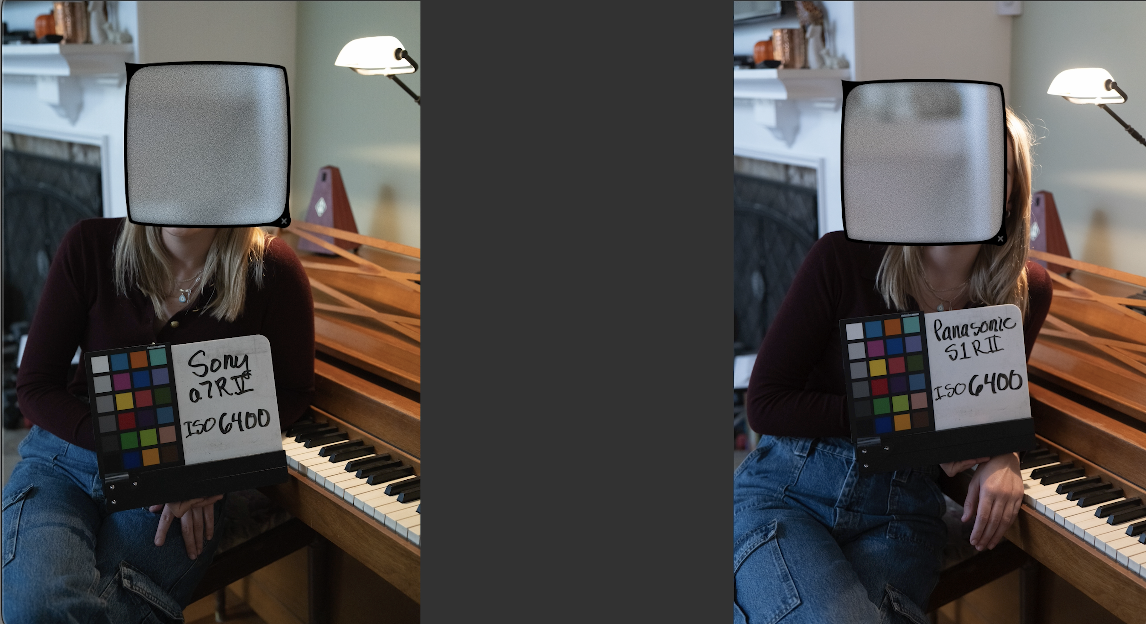 Okay, when I go to 6400 ISO, you see the digital noise in the face. You see that there’s no longer a nice skin. You don’t see a great transition from highlights to shadows. You just see a lot of that pixelation. Certainly in the background, if you take a look at that, that shadow area back there, it’s much more pronounced at the Sony than it is on the Panasonic.
 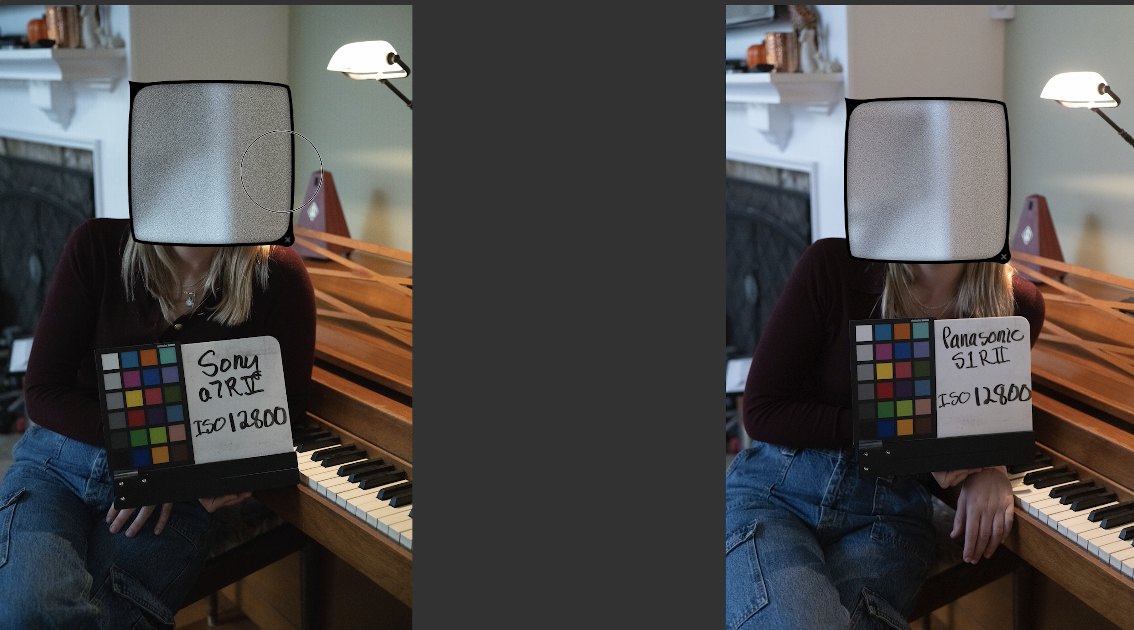 So, let’s jump up from 6,400 ISO, let’s go to 12,800 ISO and just see where we’re at on that. Yep, we see there at that point we’re just, it’s really the digital noise is very heavy in both of these. More so in the Panasonic than the Sony. Definitely, I’m feeling like the Sony is just struggling a little bit to keep up. It’s much heavier. The digital noise is much heavier than it is on the Panasonic.
 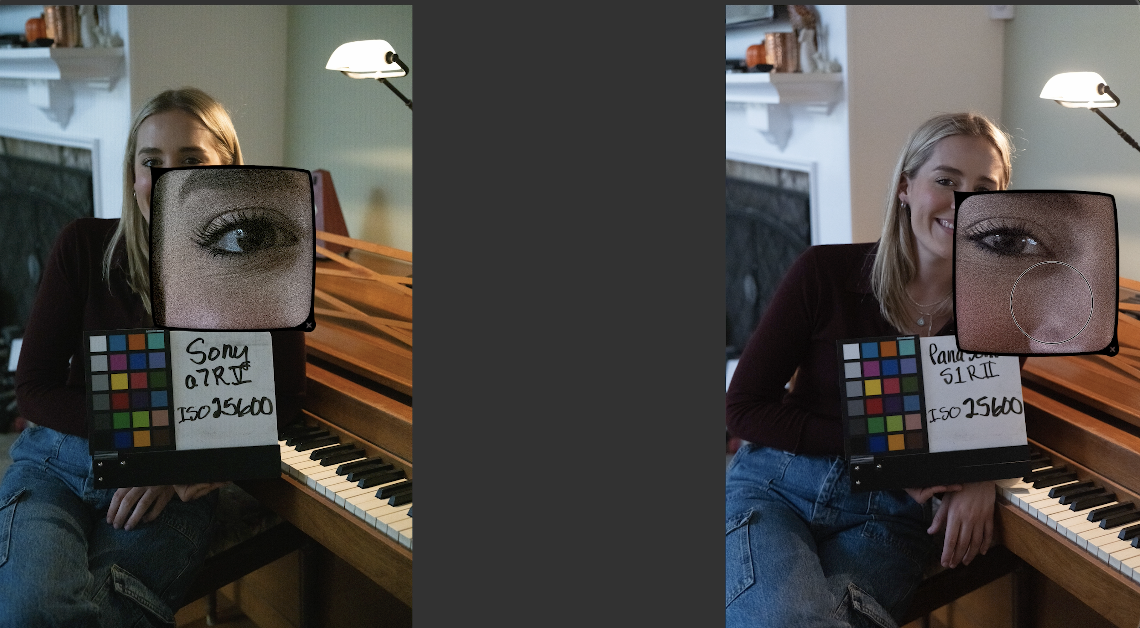 If we jump up to 25,600 ISO, now we’re really looking really digitized here. Yeah, look at that, the way the colors shifted. The digital noise on that Sony is just awful, wow, I’d have to say. The Panasonic goes up one more step.
 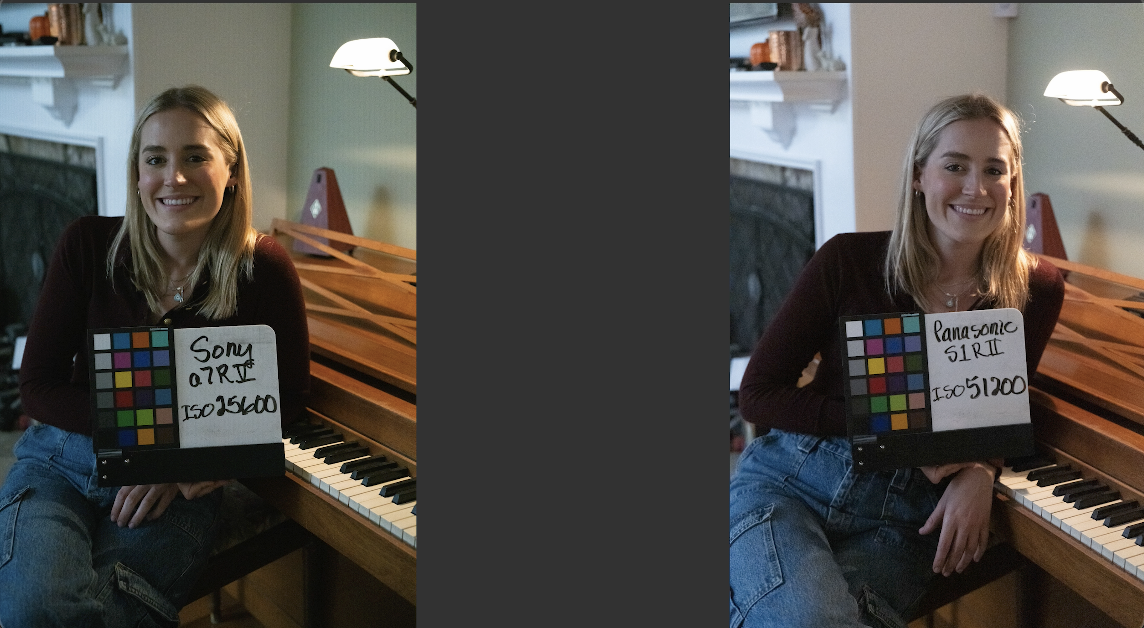 I’m curious if I hit the Sony at 25,600 ISO and I compare that to the Panasonic at 51,200 ISO. Let’s just see what that looks like in this shadow area back here. You know, there’s almost a stop difference in the ISO. The Panasonic is looking much better than the Sony. It is interesting though if you look at the background too. This showed up a little earlier along, there’s the striping here in the background in the greens you get on the Sony that you don’t get with the Panasonic. We were getting it back in here at 6400 ISO. Tiny bit definitely at 12,800 ISO. We start to see that stripe look in the Sony. There’s just some kind of a color stripe that starts to build in the greens and in the whites. So boy, when it comes to the ISO test, definitely the Panasonic is looking better than the Sony. It’s looking like almost a stop better. It’s holding things much better. Again, these are not de-noised. These are straight out of the camera raw converted. So there’s no de-noise application at all. It just gives you a pretty good idea of exactly how the sensor is going to handle the ISO. And I don’t like getting past you know, 800 ISO, 600 ISO anyway. But if you have to, definitely the Panasonic is going to look better.

Okay, let’s now take a look at the dynamic range test between these two cameras. So the dynamic range on these two cameras is very similar. 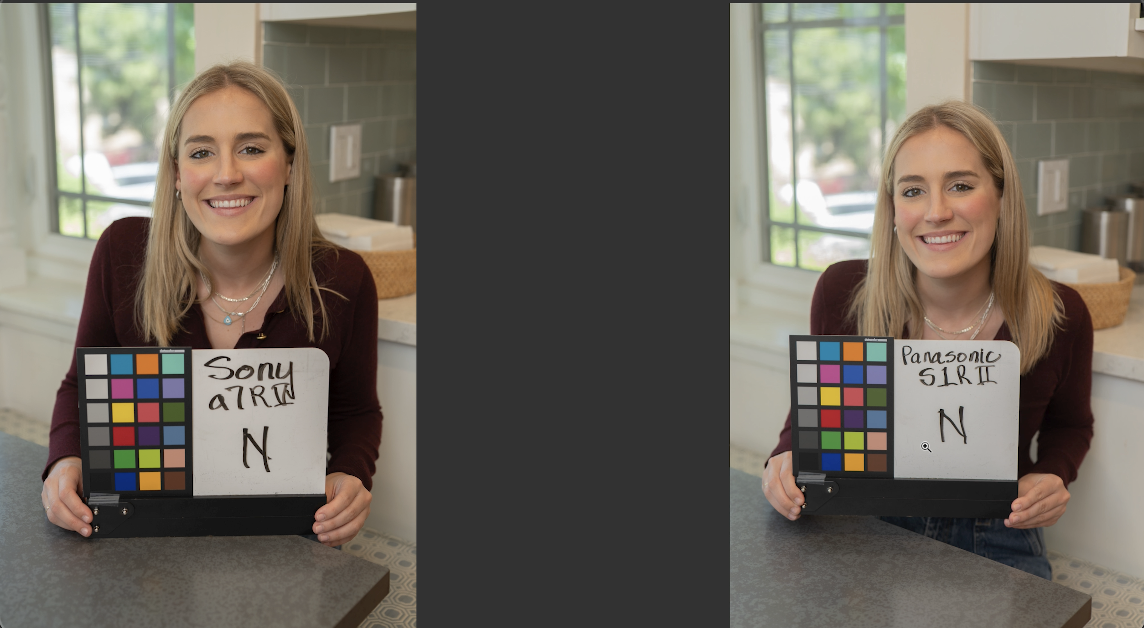 Starting off, if you look at just a normal exposure, the S1R II is holding a lot of detail in the background. It’s looking really nice. The Sony a7R V is giving us a little less. Well, they’re very similar.
 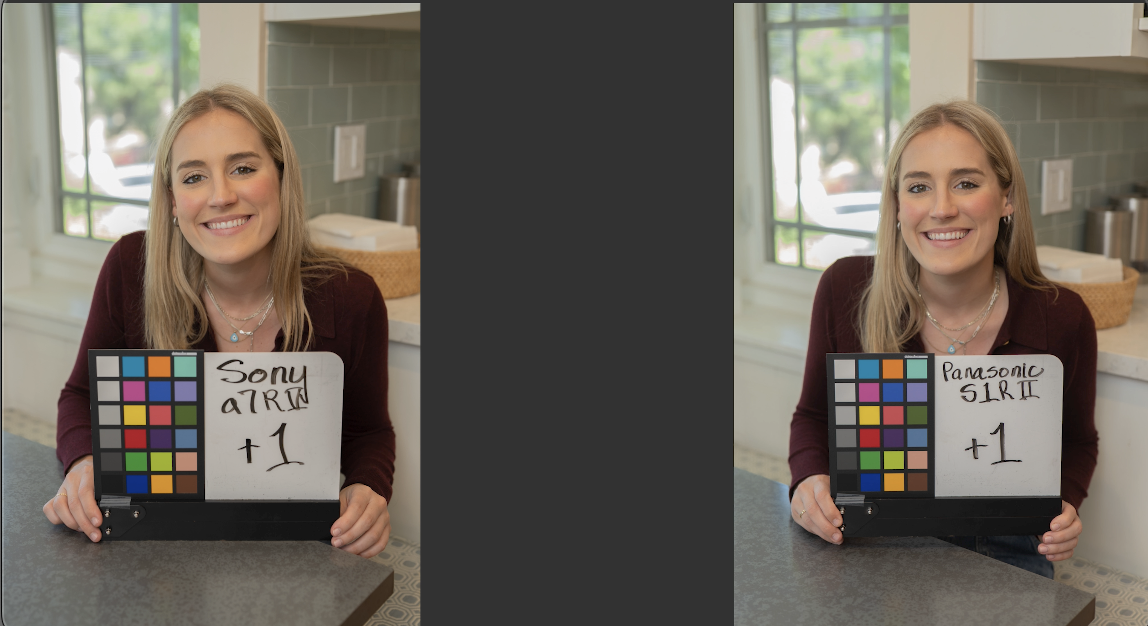 I think when we go to plus one, we’ll go to plus one here and just see exactly what we get. Let’s go to Sony. So, there plus one. Things in the background start to fall apart pretty fast. I’m seeing a little better detail with the Sony than the Panasonic. You see it up here in the greens and the patches start to develop pretty fast.
 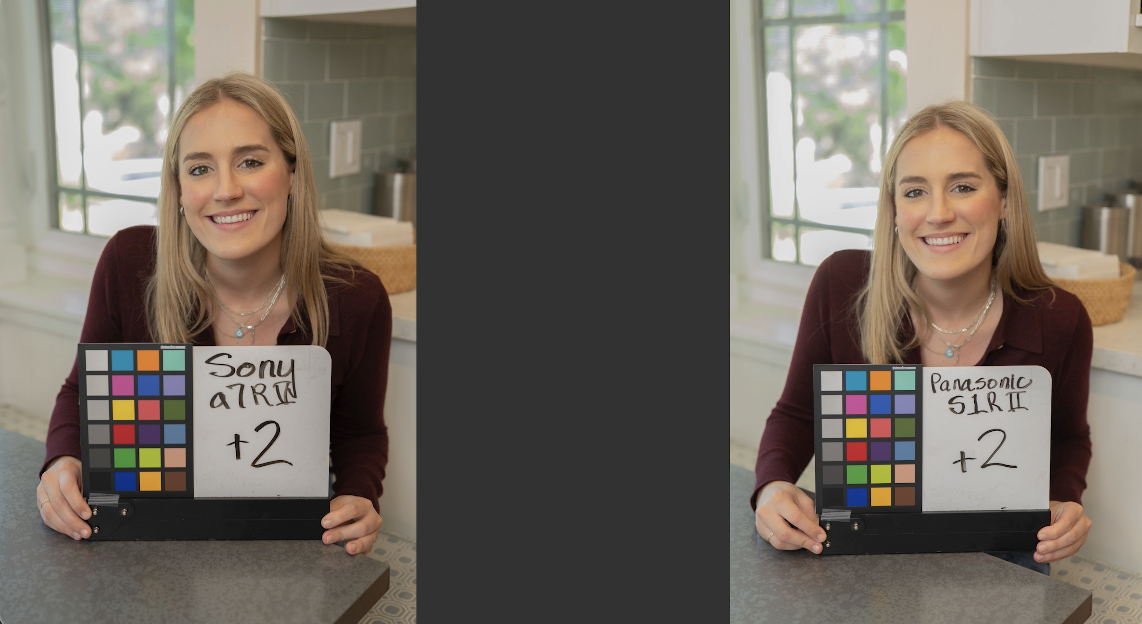 So if we go to plus two with the Sony and the Panasonic, they’re both falling apart at plus two.
  I would guess at plus three, they’re both going to look equally bad. Yellow skin, blown out background. Sony maybe looks a tiny bit better in this image. Not that anything about this image looks good, but let’s go the other direction. That’s what we really want to look at.
 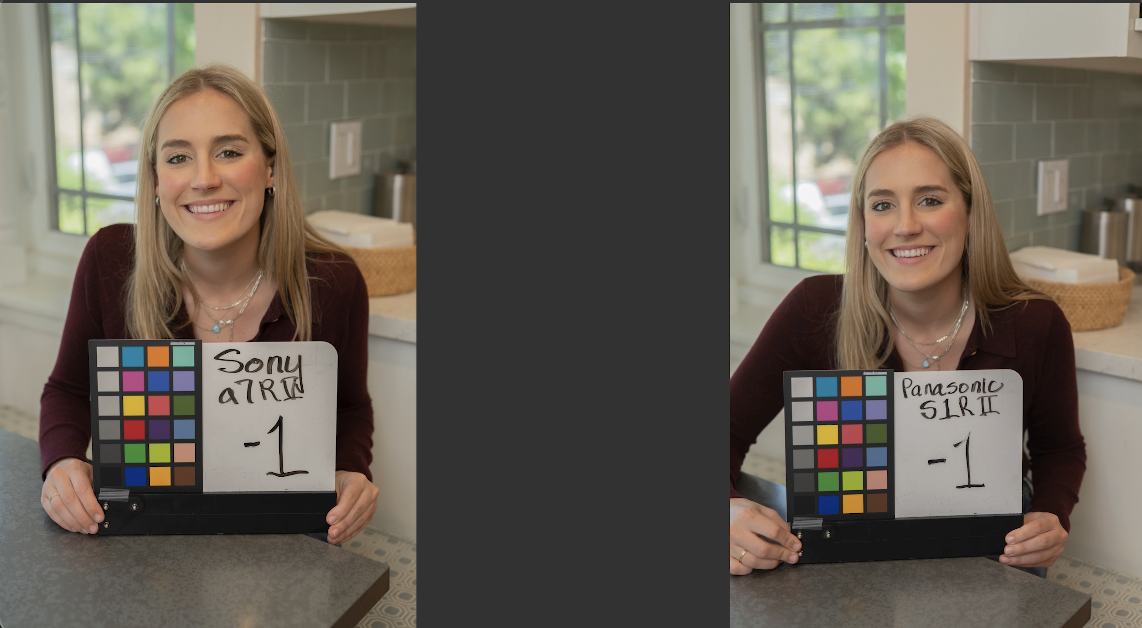 We want to look at and see what happens when we go to minus a stop. Look at the beautiful detail we’re getting in the Sony in the background. It really is nice. I’m feeling like there’s good detail outside that window. I’m seeing great detail in her face. I’m comfortable with the way it renders the color. Color is not shifting.
 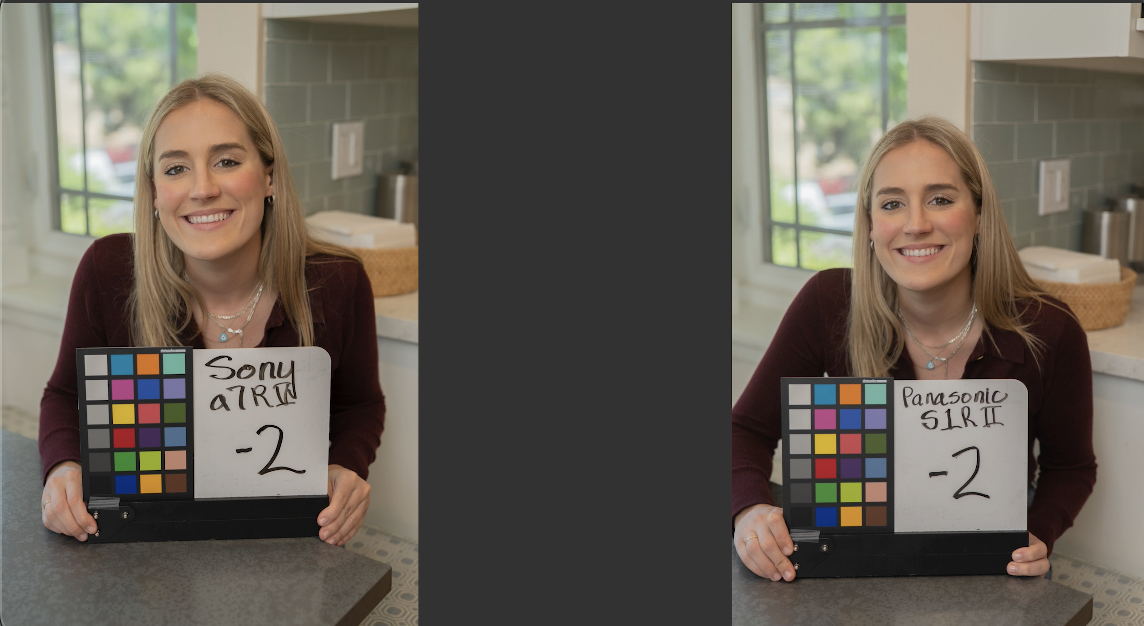 If we go to minus two, again, it’s just, I feel like the Sony is just a little bit nicer than the Panasonic. Not a lot. They’re very close to one another here, but the color rendition is still popping on the Sony. Looking really nice.
 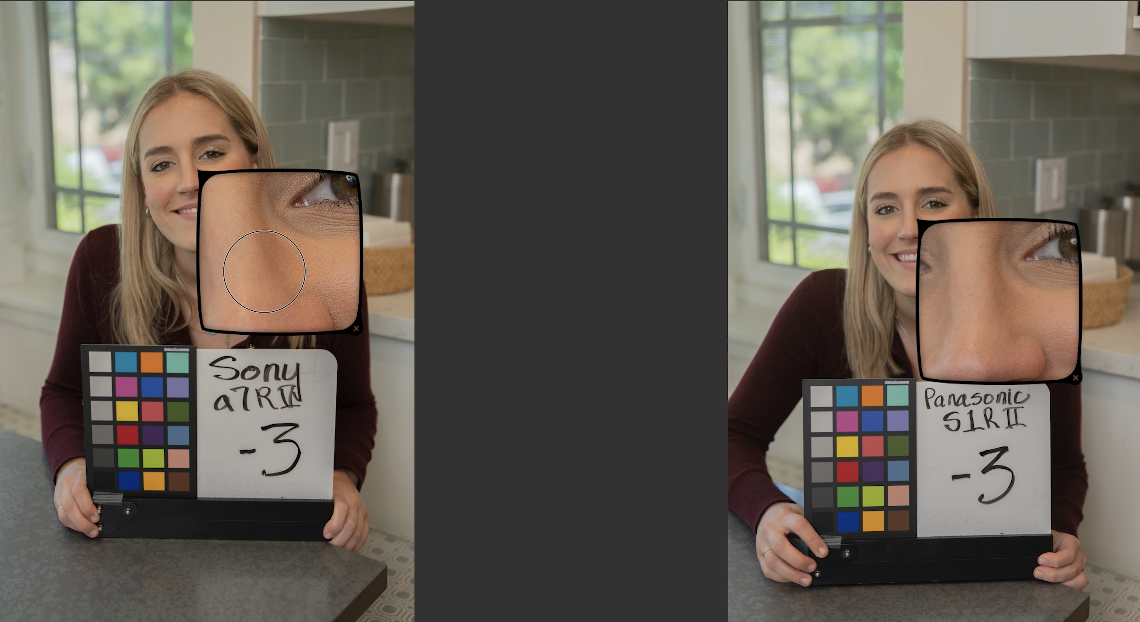 If we go to minus three. Yeah, I feel like we’re still holding better at minus three. And certainly we don’t have a lot of digital noise happening yet. Well, minus three, we’re getting just a little bit. You start to see the color shift just a little bit in the shadow from the shadows to the highlights. And it’s starting to happen here at minus three. Certainly at minus four, it’s going to happen a lot.

That bridge of that nose, you start to see it. You start to see the way that color transition there is just pretty abrupt. There’s a lot of digital kind of confusion in that area. But look out the window. We’re holding a lot of detail out in that window. We’re getting beautiful color on each of these. Minus four was definitely too far. But back in the minus one, minus two, I think Sony was just a little bit ahead when it came to dynamic range on these.

That was really interesting. I enjoy doing that test because it just gives me a really good idea of how the sensor is going to react, where I should place my exposure. I think it’s a good test to do so you understand your camera. Most of the time I’m underexposing my imagery by a quarter. or I mean a third to two thirds of a stop when I shoot.
Let me wrap this up like this. These two cameras are the two cameras that I really want. I love the Sony a7R V because I love that 61 megapixels. I love the frame rates. I get great images. I can crop in on the the images. I just absolutely love that camera as a still camera. I think it’s a great video camera and I use it as a video camera, but I think still-wise it is a just a home run camera all the way around. Love shooting on that camera, especially when I shoot and crop. I just, like I say, I just love shooting on that camera. Whereas the Panasonic is a better video camera. It gives you interface for anamorphic lenses. It has a USB-C port to be able to record to an SSD. It has a great range of codecs that allow you to really record an open gate, which I absolutely love. I think the Panasonic is a much stronger positioned camera to be a video workhorse. I don’t think the Sony’s bad. I don’t think the Panasonic is bad as a still camera, but I think if I had to choose, what I would love most of all is I really would love to have both these cameras because I think the Panasonic is an incredible video camera and the Sony is an incredible stills camera. That’s my goal. That’s my thought. I would make this decision based on, you know, really where you are in the market and what makes the most sense for you right now as far as lenses that you have. And if you’re really involved in either one of these ecosystems, you have lenses that match the camera. If you’re L-Mount, then I would stick with L-Mount, stick with the Panasonic. If you’re Sony mount, I would stick with the Sony and go down that Sony road. I don’t see a good reason to change between these two. Two incredible cameras. So, you keep those cameras rollin’ and keep on clickin’!
